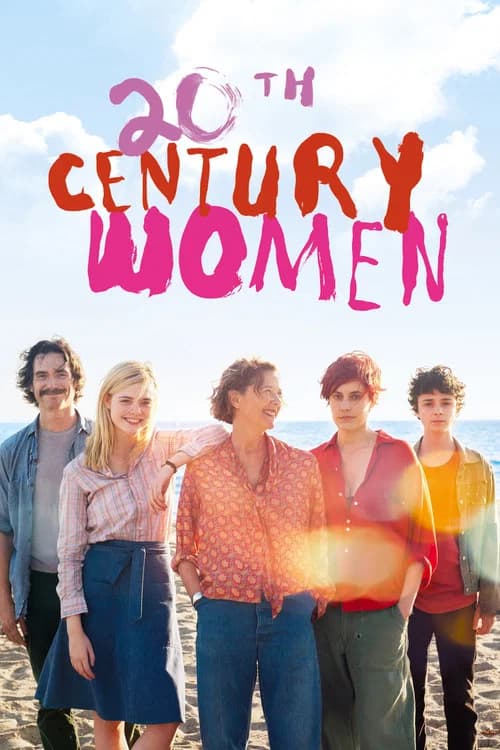
In 1979 Santa Barbara, a free-spirited single mother recruits 2 younger women to help raise her 15-year-old son. The film is narrated from an unspecified future, and each character reflects on what they couldn't understand at the time. Mike Mills' film is a love letter to the women who shaped him.
20th Century Women is a 2016 drama and comedy film directed by Mike Mills. This breakdown covers 4 techniques (3 narrative and 1 cinematography), each with the scene where you can see it. If you like how it is made, The Pianist uses several of the same techniques.
Having a narrator tell the story from some point after it happened. The events feel like memory, and you sense early on that something will be lost.
How this film uses it
Each character narrates their own story and each other's. They speak from a future that knows how things turn out, which their 1979 selves can't. Looking back this way makes every moment of connection tender, because you know how little time the characters will have together.
Where to see it
The voiceover revealing what happens to each character after the film ends. You hear about deaths, divorces and futures the 1979 characters can't imagine. Knowing the future makes the present-day scenes feel alive and mournful at the same time.
Drawing on the filmmaker's own life but keeping it at arm's length, often through a fictional stand-in. The result is precise and unsentimental, and it can question how memory flatters us.
How this film uses it
Mills puts himself into Jamie, the 15-year-old son trying to understand women he loves but can't fully know. Turning it into fiction lets him honor the women who raised him without claiming to fully understand them.
Where to see it
Jamie's voiceover admitting that even though he loved Dorothea, he never fully understood her. Mills can only admit this about his own life because it is told as fiction. The film is honest about its own limits.
Changing the color, film texture and camera style for each time period, and using the fashion and architecture of the day. Every era gets its own distinct feel.
How this film uses it
Sean Porter's photography uses the warm grain and muted colors of late-1970s photography. The punk venues are shot with the grainy texture of a concert photo. The scenes at home have the amber of a real household photograph from the period.
Where to see it
The punk concert sequence. The photography copies the specific look of 1979 concert photography. With that grain and contrast, the era feels like something you lived through and less like a recreation.
Watching events from a measured distance with no swelling music, tear-jerking close-ups or showy camera moves. The film trusts what happens to carry the weight on its own.
How this film uses it
Mills films the women's relationships with Jamie and with each other without summing up what they mean. The film's emotional intelligence is spread across the performances, the visual choices and the narration looking back. No single scene is there to explain it.
Where to see it
Dorothea dancing alone in the kitchen. The film watches without comment. The image tells you more about her than any description of her character would.
Questions
20th Century Women: quick answers
What filmmaking techniques does 20th Century Women use?
CineCode breaks down 4 techniques in 20th Century Women (2016): Retrospective Voiceover, Autobiographical Distance, Era-Coded Visual Grammar and Observational Restraint.
Who directed 20th Century Women?
Mike Mills directed 20th Century Women, released in 2016. CineCode also covers Beginners (2011), C'mon C'mon (2021).
What films are similar to 20th Century Women?
Films that share techniques with 20th Century Women include The Pianist (2002), Lady Bird (2017), Minari (2020), Au Revoir les Enfants (1987).