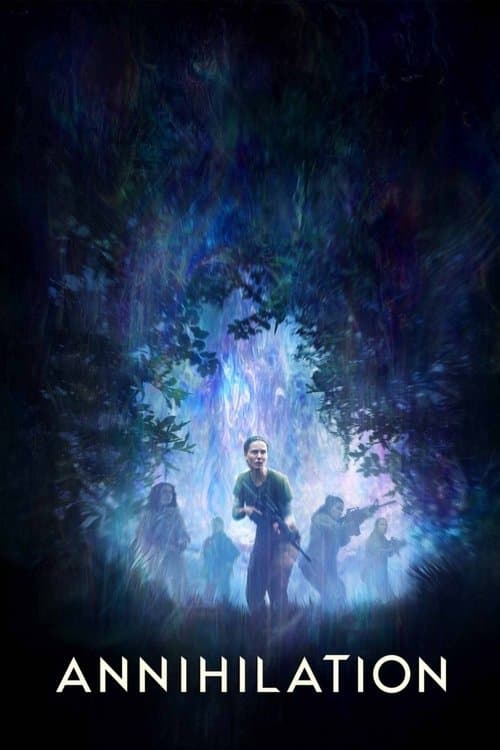
Annihilation
Alex Garland · 2018
A biologist joins an expedition into the Shimmer — a mysterious quarantined zone where the laws of biology are rewriting themselves — to discover what happened to her husband. Alex Garland's film uses the conventions of science fiction horror to explore self-destruction, identity, and the unknowability of the self.
Techniques Used
5 techniques identified in this film
Unreliable Reality
NarrativeSystematically eroding the boundary between what is real and what is imagined, making the audience as disoriented as the protagonist.
How this film uses it
The Shimmer refracts everything — radio signals, DNA, memory — and the film's nested frame structure implies that even Lena's account of events has been refracted beyond accuracy.
Hard Science Fiction Aesthetics
NarrativeGrounding fantastic premises in scientific plausibility — using real biology, physics, or psychology as the conceptual architecture of the speculative world.
How this film uses it
The Shimmer's mechanics are explained through refraction — light, radio waves, and DNA all bending — giving the inexplicable a scientific vocabulary that makes it more, not less, frightening.
Body Horror
PsychologyUsing the violation or transformation of the body as a vehicle for psychological terror.
How this film uses it
The Shimmer produces mutations that are grotesque but also beautiful — flowers growing from human shapes, a bear that speaks in its victim's voice — making biological transformation a source of simultaneous wonder and dread.
Epistemic Horror
PsychologyHorror arising not from violence or the supernatural but from the failure of understanding — the confrontation with something that cannot be known.
How this film uses it
The film's climax in the lighthouse confronts Lena with an entity that cannot be understood, communicated with, or fought — only mirrored — making incomprehension itself the horror.
Color Symbolism
CinematographyUsing specific colors to carry thematic or psychological meaning throughout the film.
How this film uses it
The Shimmer's iridescent rainbow boundary and the film's increasingly saturated, impossible colors signal the zone's transformation of matter — beauty and horror rendered in the same chromatic language.
You Might Also Like
Films that share at least one technique with Annihilation

A detective in a rain-soaked 2019 Los Angeles hunts down escaped synthetic humans called replicants, and begins to question the nature of his own humanity. The film that defined the visual grammar of cinematic dystopia.
Blade Runner
Ridley Scott · 1982

In postwar fascist Spain, a young girl named Ofelia retreats into an elaborate underground fantasy world while her cruel stepfather commands a military campaign against Republican insurgents. Del Toro's fairy tale is told with absolute moral seriousness — the fantasy is not escapism but the only form resistance can take.
Pan's Labyrinth
Guillermo del Toro · 2006

When twelve alien spacecraft appear around the world, linguist Louise Banks is recruited to decode the visitors' language — a process that begins to alter her perception of time itself. Denis Villeneuve's film uses first contact as a vehicle for a devastating meditation on grief, language, and the cost of knowing the future.
Arrival
Denis Villeneuve · 2016