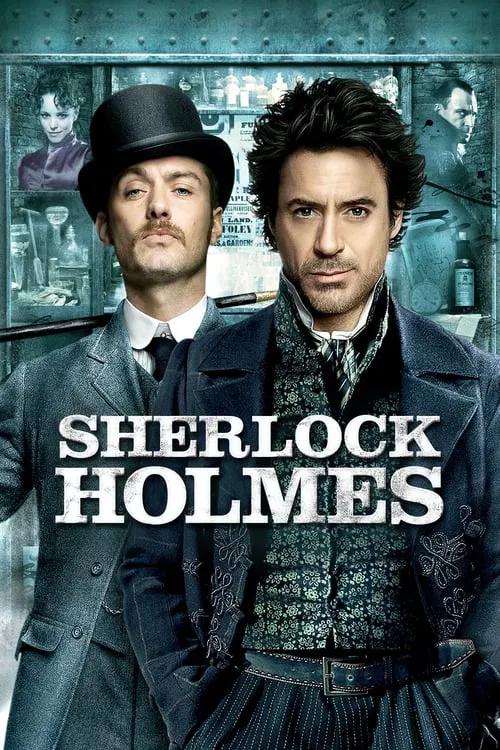
In 1890 London, detective Sherlock Holmes and Dr. Watson hunt Lord Blackwood, a hanged killer who seems to have come back with dark powers. Holmes has to prove the magic is a trick. Watch how Ritchie lets you see Holmes thinking before the fists fly.
Sherlock Holmes is a 2009 action, adventure and mystery film directed by Guy Ritchie. This breakdown covers 4 techniques (2 narrative, 1 editing and 1 cinematography), each with the scene where you can see it. If you like how it is made, Romancing the Stone uses several of the same techniques.
Revealing character and motive through physical evidence and a detective's step-by-step reasoning, with no confessions or backstory dumps. You piece together the truth alongside the investigator.
How this film uses it
Holmes treats the haunting as a puzzle with an answer. He ties the murders to the rituals of a secret order and works out where the next attack will happen. At the end he shows that every supernatural act was a stage trick built on a dead man's science experiments. You get the answer as a chain of small clues.
Where to see it
The Tower Bridge finale. After Blackwood falls, Holmes explains that his supposed magic was a set of tricks that came out of Luke Reordan's experiments.
Showing a character's plan as slow-motion images with their own narration, then replaying the action at full speed. You see the thinking first, so the fast action pays it off.
How this film uses it
Ritchie lets you inside Holmes's head before a fight. He sizes up his opponent in slow motion and tells you what he will do, then the same fight plays at full speed. It makes a brawler out of a thinker, and you feel clever for following.
Where to see it
The boxing match. Holmes narrates how he will beat his opponent, then the fight runs at full speed and follows the plan.
Mixing several genres in 1 film, such as crime, romance, horror and absurd comedy. The clash between them keeps you from settling into a single way of watching.
How this film uses it
The film is a detective story, an action film, an occult thriller and a buddy comedy at once. Holmes and Watson bicker like an old married couple while they chase a villain who seems to work real magic. The mix keeps you unsure whether the next scene will be a joke or a threat.
Where to see it
The opening raid. Holmes and Watson break up a ritual murder before Blackwood can finish it, and he is arrested.
Filming in recognizable real places so the setting acts like part of the cast. Streets, buildings and landscapes shape the mood of the story.
How this film uses it
The film uses real British places such as St Paul's Cathedral, Manchester Town Hall and Chatham Dockyard to build a rough 1890 London. The finale takes place on Tower Bridge, a real landmark that was still unfinished at that time. You feel the Victorian city as a place that is still being built.
Where to see it
The Tower Bridge fight. Blackwood and Holmes fight on the unfinished bridge, and Blackwood falls through the scaffolding.
Questions
Sherlock Holmes: quick answers
What filmmaking techniques does Sherlock Holmes use?
CineCode breaks down 4 techniques in Sherlock Holmes (2009): Forensic Inference Narration, Slow-Motion Previsualization, Genre Collage and Real Locations as Character.
Who directed Sherlock Holmes?
Guy Ritchie directed Sherlock Holmes, released in 2009. CineCode also covers Snatch (2000).
What films are similar to Sherlock Holmes?
Films that share techniques with Sherlock Holmes include Romancing the Stone (1984), Hit Man (2024), The Pelican Brief (1993), The Hangover (2009).