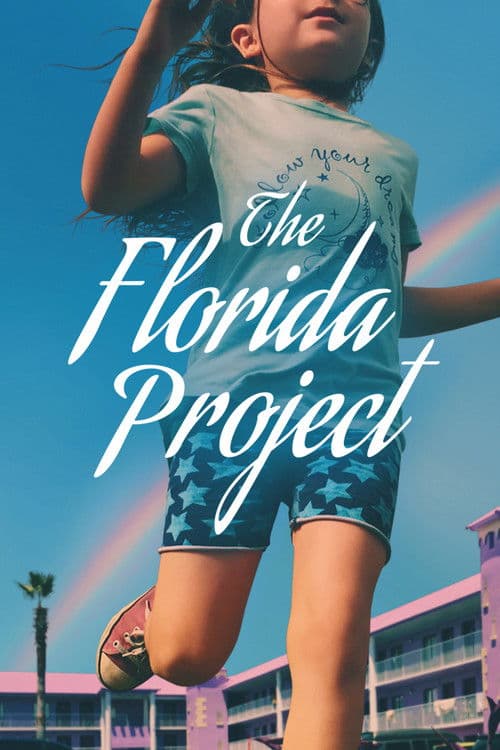
6-year-old Moonee spends a magical, unstructured summer at a budget motel on the outskirts of Disney World. Meanwhile, her young, irresponsible mother struggles to pay the rent by any means available. Sean Baker's film is a portrait of American poverty filmed from a child's eye level.
The Florida Project is a 2017 drama film directed by Sean Baker. This breakdown covers 4 techniques (2 narrative and 2 cinematography), each with the scene where you can see it. If you like how it is made, Winter's Bone uses several of the same techniques.
Having a narrator describe events in a plain, matter-of-fact way, sometimes without fully understanding them. You notice more than the narrator says, which creates irony and sympathy.
How this film uses it
Moonee experiences her mother's money troubles as a series of adventures: the motels, the hustle, the moving from room to room. Baker films the poverty from the child's point of view, where none of it is tragic yet.
Where to see it
Moonee and her friends begging for ice cream money outside a condominium. To the adults, it's a hustle. To the children, it's a game. You can read the same scene in 2 ways that don't fit together.
Casting real people from the community being shown, such as workers and local residents, with no trained actors in those roles. Their looks and behavior feel true in a way acting can't copy.
How this film uses it
Brooklynn Prince as Moonee and many of the supporting players are non-professional actors. Baker cast from the actual communities that live in extended-stay motels. You can feel real experience in the performances, and it makes what the film observes feel like testimony.
Where to see it
Moonee's scenes with the other motel children. They have the made-up-on-the-spot quality of how kids really behave. You can't tell the games and the cruelties apart from documentary footage.
Using specific working-class parts of a city, like its bars, docks and construction sites, to define the characters. The places show who they are expected to be and what leaving would cost.
How this film uses it
Baker shoots the Magic Castle motel and its purple-painted exterior against the flat Florida light, as precisely as a documentary maker would. The budget motels, the strip malls and the dollar stores all sit around the Disney World tourism economy. That economy can't house the people who serve it.
Where to see it
The final scene, where Moonee and Jancey run from the motel world to the gates of Magic Kingdom. Baker shot it secretly on an iPhone. The poverty and the fantasy are right next to each other. That closeness is pretty much the film's whole political point.
Shooting with a handheld camera so the frame shakes and moves with the action. This documentary-style look, called cinema vérité, puts you uncomfortably close to the character.
How this film uses it
Alexis Zabe shoots at child height with a handheld camera that moves with Moonee and never tries to organize her. The way it is shot commits the film to the child's point of view. You never get an adult's overview from above.
Where to see it
The children running through the abandoned condos. The camera runs with them at their speed and can't see around the next corner before they do. You get the same impulsive freedom they have.
Questions
The Florida Project: quick answers
What filmmaking techniques does The Florida Project use?
CineCode breaks down 4 techniques in The Florida Project (2017): Innocent Eye Narration, Non-Professional Cast Authenticity, Working-Class Geography and Handheld Cinema Vérité.
Who directed The Florida Project?
Sean Baker directed The Florida Project, released in 2017. CineCode also covers Tangerine (2015), Red Rocket (2021), Anora (2024).
What films are similar to The Florida Project?
Films that share techniques with The Florida Project include Winter's Bone (2010), The Battle of Algiers (1966), The 400 Blows (1959), Nomadland (2020).