Adventure · Drama · Biography

127 Hours

Danny Boyle, 2010

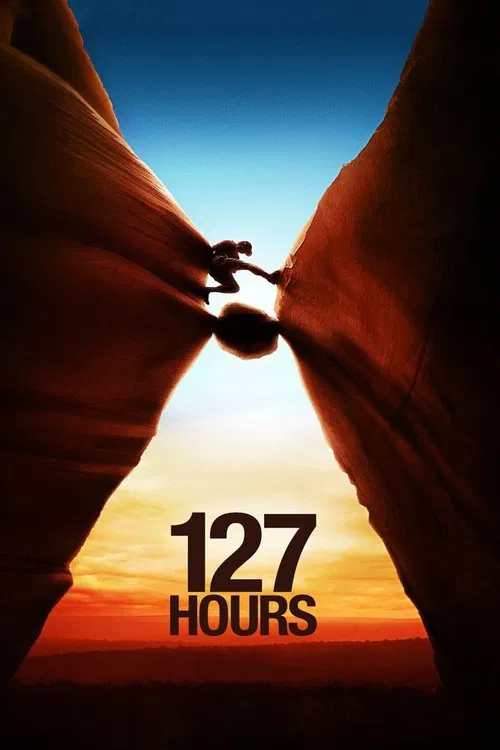
Climber Aron Ralston hikes alone into a Utah canyon, and a falling boulder pins his arm to the wall. Nobody knows where he is, so he has to find a way out himself. It is a true story with a hero who cannot move, and Boyle's job is keeping that interesting for 90 minutes.

127 Hours (2010) poster

At a glance

127 Hours is a 2010 adventure, drama and biography film directed by Danny Boyle. This breakdown covers 5 techniques (1 editing, 2 cinematography and 2 narrative), each with the scene where you can see it. If you like how it is made, Project Hail Mary uses several of the same techniques.

Editing

Split Screen

Dividing the frame into two or more images shown at once. The panels compare, overlap or accelerate action that single shots could not hold together.

How this film uses it

The film opens by splitting the screen into panels of packed crowds, such as office workers on escalators and runners fleeing bulls. Then it narrows to 1 man heading into the empty desert. The contrast shows what he is leaving behind before the canyon traps him. Split screens return later in the film.

Where to see it

The opening titles. Panels of crowds fill the screen at high speed, then the film cuts to Aron setting off alone into the Utah desert.
Cinematography

Single-Location Cinematography

Shooting almost the whole film in 1 confined place. Set design and camera movement keep it visually interesting, and the space itself takes on meaning as the story goes on.

How this film uses it

Once the boulder drops, almost everything happens in 1 narrow slot in the rock. Boyle keeps it alive with changing angles, the camcorder diary and cuts to Aron's memories of family and friends. The space feels smaller each time you come back to it.

Where to see it

The boulder falls. Aron climbs down in Bluejohn Canyon, the rock he is hanging from comes loose, and it pins his right arm against the wall.

Narrative

Physicalized Problem-Solving

Showing characters work out a mental or scientific problem through actions you can watch, with little dialogue or voiceover. You discover the answer along with them.

How this film uses it

Aron tries to solve his problem with his hands. He chips at the boulder with a pocket knife, rigs a rope pulley to lift it and slowly works out that his dull blade cannot cut through bone. You run through each failed idea with him, so the last choice feels like the only one left.

Where to see it

The rope pulley. Aron rigs a rope to lift the rock off his arm, and it fails.

Cinematography

Practical In-Camera Effects

Creating effects physically on set with makeup, prosthetics, built props and camera tricks, with no computer graphics added later. The results look solid and real.

How this film uses it

The amputation uses false arms built in layers, with fiberglass and steel bone, silicone muscle and tendon, working veins and a see-through silicone skin. James Franco said seeing blood on the arm was hard for him, and his reactions were genuine. The scene is hard to watch because the arm looks like an arm.

Where to see it

The amputation. Aron makes a tourniquet from tubing, breaks his arm using leverage and cuts through it with his multi-tool.

Narrative

Earned Catharsis

Building up to a big emotional release slowly, by investing in the characters and giving small bits of hope. When the release comes, it feels deserved after all the suffering.

How this film uses it

After 5 days of failed attempts, hunger and thirst, Aron finally gets free. He rappels down a 65 ft rock face, drinks stagnant rainwater and reaches a family of hikers who call for help. The relief hits hard because you waited through every hour with him.

Where to see it

The escape. After the amputation, Aron rappels down the canyon wall and finds a family hiking in the desert.

Questions

127 Hours: quick answers

What filmmaking techniques does 127 Hours use?
CineCode breaks down 5 techniques in 127 Hours (2010): Split Screen, Single-Location Cinematography, Physicalized Problem-Solving, Practical In-Camera Effects and Earned Catharsis.
Who directed 127 Hours?
Danny Boyle directed 127 Hours, released in 2010. CineCode also covers Shallow Grave (1994), Trainspotting (1996), A Life Less Ordinary (1997), The Beach (2000), 28 Days Later (2002), Sunshine (2007).
What films are similar to 127 Hours?
Films that share techniques with 127 Hours include Project Hail Mary (2026), Marriage Story (2019), Frankenstein (2025), The Thing (1982).