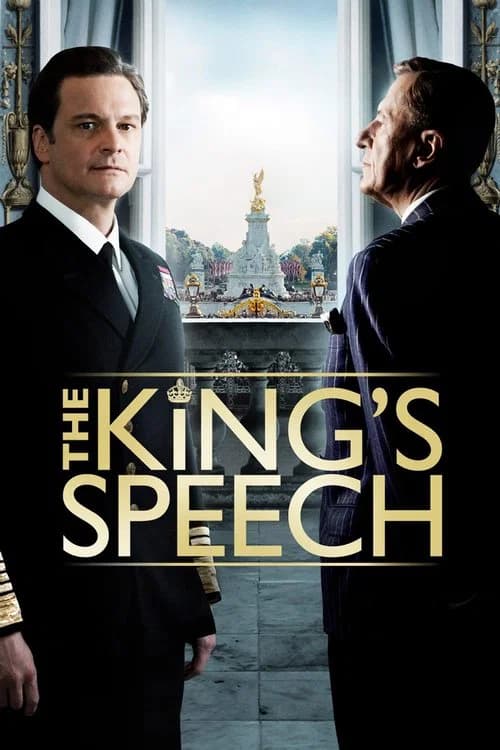
The future King George VI gets help from an unorthodox Australian speech therapist to overcome a crippling stammer in time to lead Britain into the Second World War. Tom Hooper's film looks at the vulnerability underneath royalty and at the unlikely friendship that ends up curing it.
The King's Speech is a 2010 drama and biography film directed by Tom Hooper. This breakdown covers 4 techniques (2 editing and 2 cinematography), each with the scene where you can see it. If you like how it is made, Bugonia uses several of the same techniques.
Structuring the film as a series of therapy or training sessions, each one wearing down more of the main character's defenses. They build toward one scene where all the pressure is released.
How this film uses it
The backbone of the film is Logue's sessions with Bertie, one after another. Each meeting gets closer to the wound underneath the stammer, until the wartime broadcast becomes the final test.
Where to see it
Logue making Bertie shout obscenities to break through his block. The therapy scene plays as comedy and as an emotional breaking point at once.
Using camera angles and framing to show who has power. A low angle makes a character look bigger and a high angle makes them look small. The balance can shift between shots.
How this film uses it
Tom Hooper uses wide-angle lenses and deep space so the royal palaces look cavernous and isolating. Bertie is always small inside his own privilege. Logue's therapy room, on the other hand, is close, cluttered and sized for people.
Where to see it
Bertie in Buckingham Palace's long corridors. The architecture dwarfs him, in contrast to the cramped warmth of Logue's rented consulting room.
Giving each time period or social world in the film its own set of colors. You always know where and when you are, and the colors carry a mood too.
How this film uses it
Danny Cohen's photography uses amber, grey and muted green. It makes 1930s Britain look like a world of worn-out imperial grandeur. It is beautiful, but heavy with the weight of tradition.
Where to see it
The Westminster Abbey coronation scenes. They are shot in a deep amber-gold that feels historically authentic and suffocating with duty at once.
Letting a conversation run for a long time with very few cuts. The tension builds from the actors sharing the space and from what is said, almost said and left unsaid.
How this film uses it
Hooper often holds long takes of Firth and Rush in confrontation. The camera stays close while the class and personal boundaries between their characters dissolve over all the time they spend together.
Where to see it
The session where Logue forces Bertie to reveal that his childhood stammer was brought on by emotional cruelty from nurses and siblings. The scene plays out in one continuous stretch of fairly unbearable intimacy.
Questions
The King's Speech: quick answers
What filmmaking techniques does The King's Speech use?
CineCode breaks down 4 techniques in The King's Speech (2010): Breakthrough Session Architecture, Asymmetric Power Framing, Period Color Separation and Unbroken Dialogue Scene.
Who directed The King's Speech?
Tom Hooper directed The King's Speech, released in 2010. CineCode also covers The Danish Girl (2015).
What films are similar to The King's Speech?
Films that share techniques with The King's Speech include Bugonia (2025), The Godfather Part II (1974), Pulp Fiction (1994), The Matrix (1999).