Horror · Science Fiction · Drama

Frankenstein

Guillermo del Toro, 2025

In 1857, a ship trapped in Arctic ice takes in a dying Victor Frankenstein, and soon his creation comes looking for him. Victor tells how he built the Creature, then the Creature tells its own side. Guillermo del Toro turns Mary Shelley's novel into a tragedy about fathers and sons, built on huge handmade sets.

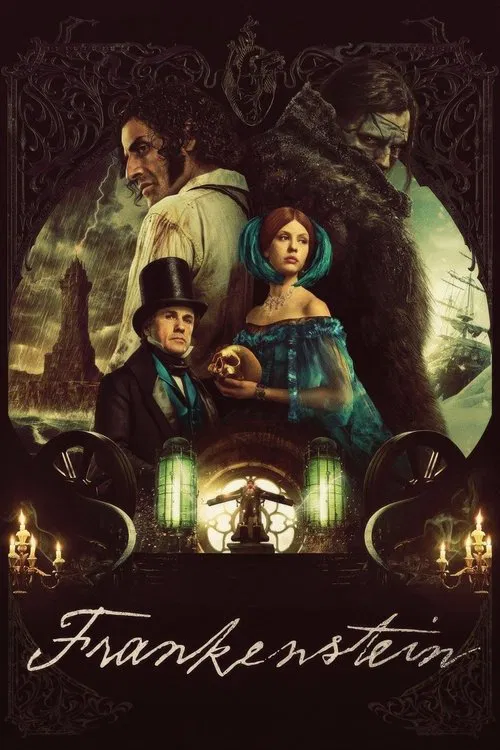
Frankenstein (2025) poster

At a glance

Frankenstein is a 2025 horror, science fiction and drama film directed by Guillermo del Toro. This breakdown covers 4 techniques (2 narrative, 1 psychology and 1 cinematography), each with the scene where you can see it. If you like how it is made, Top Gun: Maverick uses several of the same techniques.

Narrative

Multiple Perspective Chapters

Splitting a film into chapters that each follow a different character's point of view. Events overlap, so a scene you already saw comes back from another side and means something new.

How this film uses it

The film is split into Victor's tale and the Creature's tale. In part 1, Victor tells the ship's captain his version, where he is the misunderstood genius. In part 2, the Creature picks up the story and shows you what Victor left out. Your sympathy flips from the maker to the made.

Where to see it

The lab fire. Victor's tale ends with him setting the tower on fire with the Creature inside, and the Creature's tale begins with it surviving the explosion.

Psychology

Psychological Doubling

Pairing the main character with a second character who mirrors them. The double shows what the hero wants, fears or secretly is.

How this film uses it

Victor's father was cold and harsh with him. When the Creature wakes up, Victor treats it with the same cruelty. The film keeps asking which of the 2 is the real monster.

Where to see it

William's death. Mortally wounded, Victor's brother calls Victor a "monster" before he dies.

Cinematography

Practical In-Camera Effects

Creating effects physically on set with makeup, prosthetics, built props and camera tricks, with no computer graphics added later. The results look solid and real.

How this film uses it

Del Toro wanted a handmade movie at an epic scale. The sets are massive, and Victor's tower was also built as a 26-foot model that cinematographer Dan Laustsen could light like a real building. The Creature's look comes from makeup work that won the Oscar.

Where to see it

The creation sequence. Victor stitches a body together from executed criminals and dead soldiers in his tower, and lightning strikes as planned, but at first nothing happens.

Narrative

Earned Catharsis

Building up to a big emotional release slowly, by investing in the characters and giving small bits of hope. When the release comes, it feels deserved after all the suffering.

How this film uses it

After so much cruelty, the film ends with Victor and the Creature making peace on the ship. They call each other father and son before Victor dies. The Creature then frees the ship from the ice so the crew can go home.

Where to see it

The final scene on the ice. The Creature reaches toward the sunlight that Victor once taught it to love.

Questions

Frankenstein: quick answers

What filmmaking techniques does Frankenstein use?
CineCode breaks down 4 techniques in Frankenstein (2025): Multiple Perspective Chapters, Psychological Doubling, Practical In-Camera Effects and Earned Catharsis.
Who directed Frankenstein?
Guillermo del Toro directed Frankenstein, released in 2025. CineCode also covers Cronos (1993), Mimic (1997), The Devil's Backbone (2001), Blade II (2002), Hellboy (2004), Pan's Labyrinth (2006).
What films are similar to Frankenstein?
Films that share techniques with Frankenstein include Top Gun: Maverick (2022), The Ice Storm (1997), 127 Hours (2010), Lost Highway (1997).