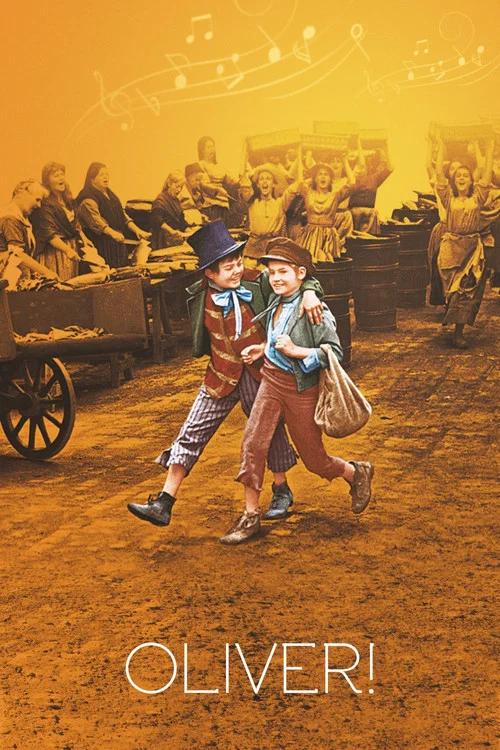
Based on the stage musical of Dickens's Oliver Twist, it follows an orphan who asks for more food, runs away to London and falls in with a gang of child pickpockets led by Fagin. Carol Reed fills Shepperton Studios with songs, crowds and streets. Watch how the music does the storytelling.
Oliver! is a 1968 musical, drama and family film directed by Carol Reed. This breakdown covers 5 techniques (2 sound, 1 narrative, 1 cinematography and 1 psychology), each with the scene where you can see it. If you like how it is made, Annie uses several of the same techniques.
Writing songs for the film that carry story, feeling or payoff. Characters burst into music or a theme song resolves the plot.
How this film uses it
The songs carry plot and feeling. Where Is Love shows Oliver's loneliness, and Consider Yourself shows him being welcomed. When characters feel something big, they sing it.
Where to see it
Food, Glorious Food. The workhouse orphans sing about food, and Oliver draws the short straw and asks for more.
Having ordinary people in a public place break into coordinated movement, so a private feeling becomes a shared event.
How this film uses it
In Consider Yourself, a private moment of welcome turns into a shared event. The Artful Dodger leads Oliver through the streets, and Londoners join in the singing and dancing. The song turns a lonely boy into part of a crowd.
Where to see it
Consider Yourself. The Dodger takes Oliver through London, and the street fills with people singing and dancing.
Using a song or music contest to show who a character is or what they stand for. The music works as argument, duel or revelation.
How this film uses it
Nancy sings As Long as He Needs Me to show she loves Sikes even though he is violent. The song tells you why she stays with him. It also makes her later death at his hands harder to watch.
Where to see it
Nancy's song. She sings of her loyalty to Sikes, and later he kills her at London Bridge.
Building a set so complete, with its own weather, crowds, architecture and social rules, that it feels lived in. It reads as real until one deliberate slip shows that it was built.
How this film uses it
The film was shot at Shepperton Studios, and its art direction won an Academy Award. The workhouse, the markets and the bridge all feel like a lived-in city, built inside a studio. Its crowded streets tell you how crowded Oliver's world is.
Where to see it
London Bridge. Nancy tries to free Oliver from Sikes, and Sikes kills her.
Putting an innocent person under blame or suspicion and showing the damage it does to them and those near them. The accusation distorts the community's judgment.
How this film uses it
Oliver is accused of a theft he did not commit. The accusation turns a crowd on him, and he is only saved when a stranger, Mr. Brownlow, takes him in. Fear of being blamed follows him afterward.
Where to see it
The bookstall. Oliver is wrongly accused of picking a pocket and is taken in by Mr. Brownlow.
Questions
Oliver!: quick answers
What filmmaking techniques does Oliver! use?
CineCode breaks down 5 techniques in Oliver! (1968): Original Songs as Narrative, Public Space Turned Dance, Song as Character Expression, Set as Total World and Wrongful Accusation Pressure.
Who directed Oliver!?
Carol Reed directed Oliver!, released in 1968. CineCode also covers The Third Man (1949).
What films are similar to Oliver!?
Films that share techniques with Oliver! include Annie (1982), Popeye (1980), Paths of Glory (1957), Your Name (2016).