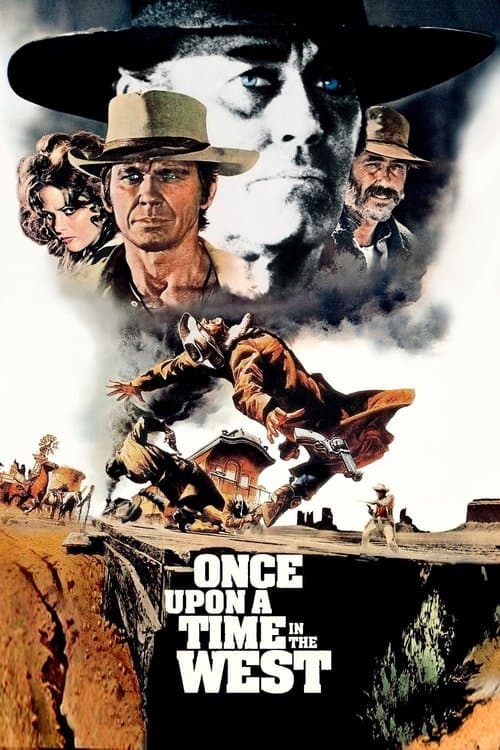
Once Upon a Time in the West
Sergio Leone · 1968
A mysterious harmonica-playing gunman, a ruthless assassin, a newly widowed woman, and a bandit caught between them converge on a piece of land that the arriving railroad makes suddenly valuable. Leone's operatic Western interrogates the mythology of the American frontier.
Techniques Used
5 techniques identified in this film
Extended Silent Opening
EditingA pre-title sequence of extraordinary duration with almost no dialogue — using sound effects, small gestures, and the accumulation of time to build tension, demonstrating that cinema can hold attention without speech or action.
How this film uses it
The 12-minute opening shows three gunmen waiting at a station. A dripping water pipe, a fly on a face, a creaking weathervane — these are the scene's content. Leone proves that patience is a cinematic instrument, that anticipation can be built to almost unbearable intensity before anything happens.
Face-Landscape Intercutting
CinematographyIntercutting extreme close-ups of human faces — eyes, hands, mouths — with vast wide shots of landscape, treating both as equally monumental visual terrain and generating tension through the alternation of scale.
How this film uses it
Leone and cinematographer Tonino Delli Colli cut between irises and horizons. A man's eye in extreme close-up is as large as a mountain range. The intercutting argues that in a Leone Western, interior psychological states and exterior landscape are the same order of phenomenon — both are terrain to be surveyed and crossed.
Withheld Backstory Revelation
NarrativeWithholding the protagonist's origin and motivation until the film's final scene — making the entire preceding narrative generate dread and fascination from an absence, the revelation arriving as the story's last breath.
How this film uses it
Harmonica's reason for hunting Frank is withheld for the entire film. Every scene between them is charged by something the audience cannot name. When the flashback finally arrives — the boy, the bridge, the harmonica forced into his brother's dying mouth — the film's structure is revealed as a single long withholding.
Ennio Morricone Pre-Score
SoundComposing the score before shooting begins and playing it on set during filming, so that performances are synchronized to music rather than music being composed to match performances — inverting the normal relationship between music and image.
How this film uses it
Leone gave Morricone's completed score to actors and played it on set speakers during takes. Henry Fonda heard his character's theme while performing. The harmonica motif was conceived as both music and as the literal object Harmonica carries. The film's emotional rhythms were musical before they were cinematic.
Railroad Genre Elegy
NarrativeUsing the arriving railroad — historical modernization — as the force that destroys the mythological West and makes the gunfighter's world obsolete, turning the Western into an elegy for its own mythology.
How this film uses it
The railroad is not just a plot element — it is the film's argument. The world of the gunfighter cannot survive the arrival of commerce, law, and steam. Leone builds a Western at the exact moment when the Western's world would cease to exist, making the genre's conventions into historical artifacts.