Science Fiction

2001: A Space Odyssey

Stanley Kubrick, 1968

The film has 3 movements separated by millions of years. It follows humanity's relationship to a mysterious monolith, from prehistoric Africa to a journey beyond the infinite. Kubrick gives up on plot and goes for pure experience. He pushes film as far into philosophy as it can go.

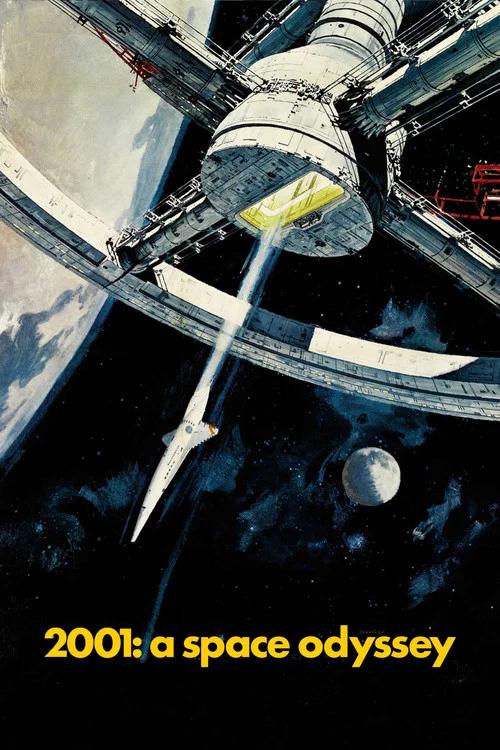
2001: A Space Odyssey (1968) poster

At a glance

2001: A Space Odyssey is a 1968 science fiction film directed by Stanley Kubrick. This breakdown covers 5 techniques (1 editing, 1 sound, 2 cinematography and 1 narrative), each with the scene where you can see it. If you like how it is made, Stoker uses several of the same techniques.

Editing

Match Cut as Thematic Argument

Cutting between 2 images that look alike in order to connect what they mean. The match gives you an idea about how the 2 things relate, on top of a smooth transition.

How this film uses it

A prehistoric ape throws a bone into the air, and the film cuts to a nuclear weapon satellite orbiting Earth. This is a match cut, where 2 similar shapes are joined across an edit. It skips 4 million years. It argues that all human technology continues from that first weapon, the same urge at a bigger scale. As a matter of fact, no other film states its main idea in so little time.

Where to see it

The bone to satellite cut. It takes 2 objects and 4 million years and joins them with a single edit.

Sound

Classical Music as Score

Using existing classical pieces as the soundtrack, with no newly composed score. The music brings its own history, cultural weight and emotion into the film.

How this film uses it

Kubrick had commissioned a score from Alex North, then rejected it and used Strauss, Ligeti and Khachaturian. The Blue Danube waltz in the shuttle docking sequence makes the technology graceful and ordinary at the same time. Ligeti's clashing clusters of notes make the monolith feel alien in a way a normal film score never could.

Where to see it

The Orion shuttle docking with the space station to The Blue Danube. The technology is made to waltz.

Cinematography

Practical Impossible Set

Building a physical set, such as one that rotates or stands for extra dimensions, to make an impossible space readable on camera. The engineering is visible in the result.

How this film uses it

The Discovery One centrifuge set was a real rotating drum, 38 feet across, and it cost $750,000 to build. Kubrick and cinematographer Geoffrey Unsworth filmed Gary Lockwood jogging through a complete rotation. The camera was fixed to the set and turned with it, so the actor appears to walk on the ceiling.

Where to see it

Frank Poole jogging through the centrifuge. The camera rotates with the set to show a full 360-degree turn.

Narrative

Symbolic Object

Returning to the same physical object again and again until it means more than what it is. It moves the plot and also stands for the film's main ideas.

How this film uses it

The monolith is never explained. It appears at each big step in human development (at the dawn of tool use, on the moon, near Jupiter and in Bowman's final room), and you never learn its purpose. Kubrick and Clarke designed it to be impossible to explain. It is like a Rorschach inkblot, and you fill it with whatever you bring.

Where to see it

The monolith's appearance on the moon. Each time it comes back, it gains meaning without any explanation.

Cinematography

Slit-Scan Psychedelic Abstraction

Moving the camera toward a lit slit while the film is exposed, which creates streaking tunnels of pure light and color. It is used to show states of mind beyond normal experience.

How this film uses it

Douglas Trumbull developed the slit-scan process, a way of photographing streaks of moving light, specifically for the Stargate sequence. He spent months creating images of pure abstract light. The sequence tells no story. It is an experience, designed to put you inside Bowman's mind as he travels past the limits of known space.

Where to see it

The Stargate sequence. It is a long stretch of pure abstract image and sound.

Questions

2001: A Space Odyssey: quick answers

What filmmaking techniques does 2001: A Space Odyssey use?
CineCode breaks down 5 techniques in 2001: A Space Odyssey (1968): Match Cut as Thematic Argument, Classical Music as Score, Practical Impossible Set, Symbolic Object and Slit-Scan Psychedelic Abstraction.
Who directed 2001: A Space Odyssey?
Stanley Kubrick directed 2001: A Space Odyssey, released in 1968. CineCode also covers Fear and Desire (1953), Killer's Kiss (1955), The Killing (1956), Paths of Glory (1957), Spartacus (1960), Lolita (1962).
What films are similar to 2001: A Space Odyssey?
Films that share techniques with 2001: A Space Odyssey include Stoker (2013), The Shawshank Redemption (1994), Interstellar (2014), Léon: The Professional (1994).