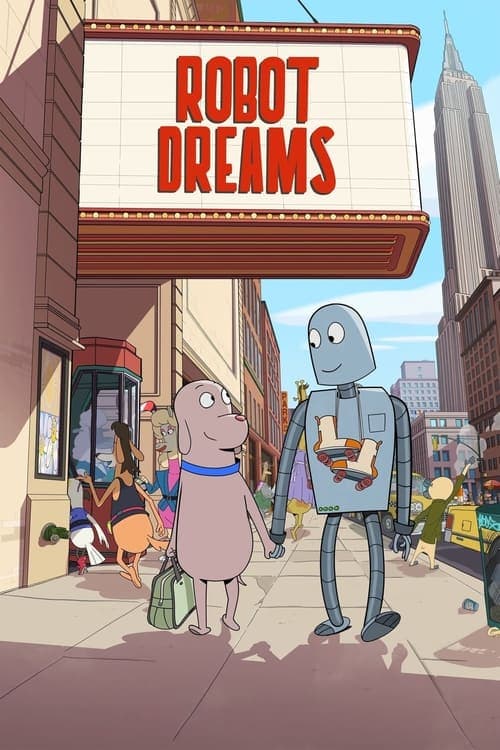
A lonely dog in 1980s New York City builds a robot friend from a mail-order kit. The 2 of them have a perfect summer together. Then, the robot gets stranded on a beach and the dog can't get him back. The rest of the film follows each of them as they try to move on. It's an animated film with no words at all, about how a connection stays with you.
Robot Dreams is a 2023 animation and drama film directed by Pablo Berger. This breakdown covers 4 techniques (1 narrative, 2 editing and 1 cinematography), each with the scene where you can see it. If you like how it is made, Flow uses several of the same techniques.
Opening the film with a long stretch that has no dialogue. Images, sound and performance alone set up the characters, their world and what is at stake.
How this film uses it
Berger's film has no dialogue for its entire 102-minute runtime. You learn about the friendship between Dog and Robot only through pictures, movement and music. I feel like having no words makes their bond easier to read.
Where to see it
Dog building Robot from the mail-order kit. You see the waiting, the assembly and the first moment Robot switches on, all without a word. That one sequence sets up the feeling the whole film runs on.
Using animation, for a whole film or for short sequences inside live action, to make emotions hit harder. Drawn images can show inner feelings that realistic footage can't reach.
How this film uses it
The film is set in a cartoon 1980s New York of diners and roller discos, where every character is an animal who acts like a person. Berger uses that world to show pure emotion. Because it's this stylized, you feel the dog's loneliness and the robot's isolation first and follow the plot second.
Where to see it
Robot stranded on the beach in winter. He lies still under snow and rain, and the animation makes it fairly sad to watch. A robot with feelings is impossible, and somehow that makes you feel for him more.
Filming city crowds as they keep moving around one person's tragedy without noticing. The scale of the city makes private disaster invisible and shows how alienated people have become.
How this film uses it
Berger's New York is full of animal New Yorkers going about their day. None of them notice Dog's loneliness or Robot's trouble. Because the city doesn't care, the 2 of them need their friendship, and losing it is devastating.
Where to see it
Dog walking through the crowded city after losing Robot. The crowd flows around him and nobody pays attention. With all those strangers around, you notice the gap left by the one companion who is missing.
Holding on quiet shots of characters watching and taking in the world around them, without cutting away. Glances, gestures and shared silence carry as much as any action.
How this film uses it
Berger stays with Robot on the beach as the seasons change, from summer to autumn to winter to spring. The scenes run long on purpose. You feel time passing and you feel the waiting, and that becomes the main emotion of the film.
Where to see it
The time-lapse of seasons passing over the stranded Robot. The film is patient enough that you feel the months pile up. Each season plays like a new chapter, and nothing that happens in the plot can end the wait.
Questions
Robot Dreams: quick answers
What filmmaking techniques does Robot Dreams use?
CineCode breaks down 4 techniques in Robot Dreams (2023): Dialogue-Free Opening Act, Animation as Emotional Amplifier, Urban Crowd Indifference and Silent Observation Pacing.
Who directed Robot Dreams?
Pablo Berger directed Robot Dreams, released in 2023. CineCode also covers Blancanieves (2012).
What films are similar to Robot Dreams?
Films that share techniques with Robot Dreams include Flow (2024), Spirited Away (2001), Grave of the Fireflies (1988), WALL-E (2008).