Comedy · Music · Family

The School of Rock

Richard Linklater, 2003

Dewey Finn is a broke guitarist who gets fired from his band, then pretends to be his roommate to land a substitute teaching job at a stuffy prep school. He secretly turns his class into a rock band for the Battle of the Bands. Watch how real young musicians playing real instruments make the finale feel like an actual gig.

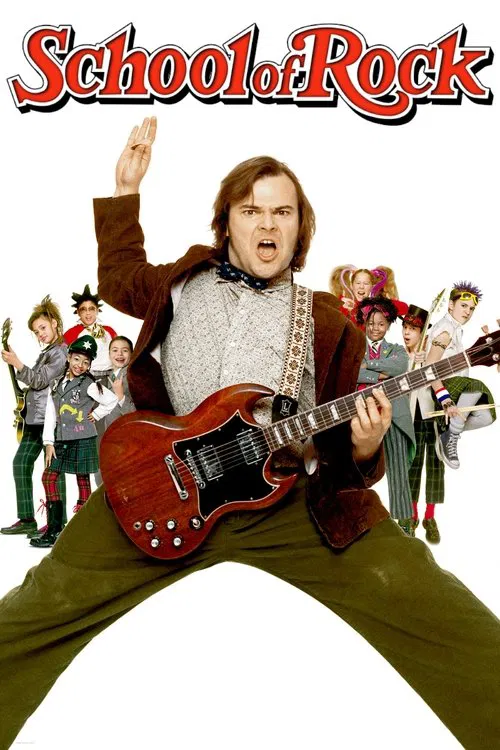
The School of Rock (2003) poster

At a glance

The School of Rock is a 2003 comedy, music and family film directed by Richard Linklater. This breakdown covers 4 techniques (2 narrative, 1 editing and 1 sound), each with the scene where you can see it. If you like how it is made, Rocky uses several of the same techniques.

Narrative

Fish-Out-of-Water Comedy

Dropping a character into a world whose social rules they don't understand. The comedy, and some insight too, comes from the constant mismatch between them and everyone around them.

How this film uses it

Dewey knows nothing about teaching and the school knows nothing about Dewey. He shows up as "Mr. S" and behaves so erratically that the class has no idea what to make of him. The gap between his slacker habits and the school's rules drives the early jokes.

Where to see it

Dewey's first day as Mr. S: After answering a phone call meant for his roommate Ned, Dewey impersonates him, gets hired and walks into class acting erratically.
Editing

Mentor Training Montage

Squeezing a long period of training under a teacher into a short sequence of quick clips. You watch failed attempts turn into small wins, which makes the student's growth believable.

How this film uses it

Dewey overhears the kids in music class and decides to turn them into a band. He plays Zack riffs like "Iron Man" and "Smoke on the Water" and gives every other kid a job, from backup singer to roadie. The film moves through the practice quickly, so each kid's growth feels earned.

Where to see it

Dewey teaching Zack the riffs: Dewey plays Zack famous guitar riffs, and the lessons turn a kid with a disapproving father into the band's lead guitarist.

Sound

Diegetic Musical Performance

Letting characters perform the songs on screen, so the music comes from their own hands and voices. You hear the song and the performer's nerves at the same time.

How this film uses it

Linklater searched the country for talented 13-year-old musicians, so the kids you see playing are really playing. When the band performs, you hear the song and the kids' nerves at once. That makes the finale feel like a live gig.

Where to see it

The Battle of the Bands: The class plays a song written by Zack, and a crowd that first sees them as a gimmick ends up won over.

Narrative

Redefined Victory

Changing what counts as winning partway through the story, so the hero chases a smaller, personal goal. The ending can then feel like a triumph even when the hero loses.

How this film uses it

Dewey starts out wanting to beat his old band. By the end, he wants the kids to have a night they will never forget. The ending lets you cheer even though the band does not take the top prize.

Where to see it

The announcement after the Battle of the Bands: No Vacancy wins the contest, but the audience is on the side of School of Rock.

Questions

The School of Rock: quick answers

What filmmaking techniques does The School of Rock use?
CineCode breaks down 4 techniques in The School of Rock (2003): Fish-Out-of-Water Comedy, Mentor Training Montage, Diegetic Musical Performance and Redefined Victory.
Who directed The School of Rock?
Richard Linklater directed The School of Rock, released in 2003. CineCode also covers Dazed and Confused (1993), Before Sunrise (1995), Before Sunset (2004), A Scanner Darkly (2006), Bernie (2012), Before Midnight (2013).
What films are similar to The School of Rock?
Films that share techniques with The School of Rock include Rocky (1976), Alice Doesn't Live Here Anymore (1974), Star Wars: The Empire Strikes Back (1980), Back to the Future (1985).