Comedy · Drama

Carnage

Roman Polanski, 2011

After two grade-school boys fight in a park, their parents meet in a Brooklyn apartment to sort it out politely. Alcohol and small insults soon turn the meeting into a four-way war. Almost the whole film is one apartment, a handy lesson in how to keep a stage play moving on screen.

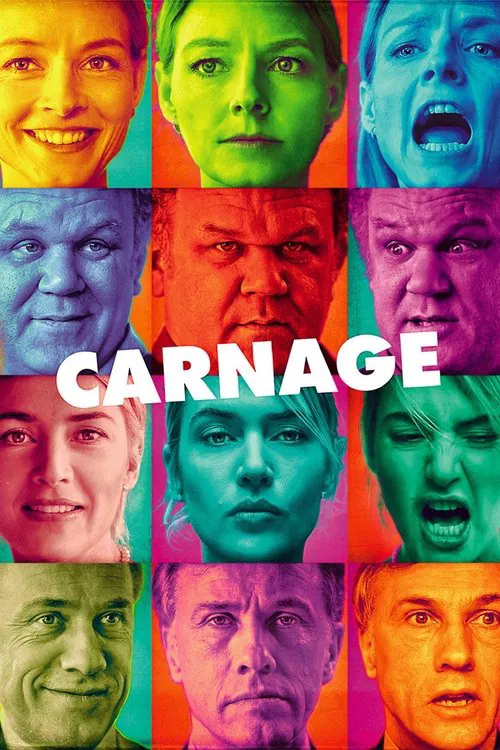
Carnage (2011) poster

At a glance

Carnage is a 2011 comedy and drama film directed by Roman Polanski. This breakdown covers 4 techniques (1 cinematography, 2 narrative and 1 psychology), each with the scene where you can see it. If you like how it is made, Night of the Hunter uses several of the same techniques.

Cinematography

Single-Location Cinematography

Shooting almost the whole film in 1 confined place. Set design and camera movement keep it visually interesting, and the space itself takes on meaning as the story goes on.

How this film uses it

Almost every scene happens inside the Longstreets' apartment, which was built as a set in a sound studio outside Paris for a story set in Brooklyn. The guests keep trying to leave and keep getting pulled back, so the room starts to feel like a trap.

Where to see it

The doorway goodbyes: Alan and Nancy start to leave twice but are drawn back into the argument.
Narrative

Circular Structure

Ending the film where it started, or with a scene that echoes the opening. The repeat shows what has changed, or suggests the cycle will keep going.

How this film uses it

The film opens and closes in the park, filmed from far away. At the end, the boys are making up on their own. The adults spent the whole film on a problem the children had already solved.

Where to see it

The final park shot: After the adults give up, the film cuts to the hamster alive in the park, where the two boys are reconciling.

Narrative

Symbolic Object

Returning to the same physical object again and again until it means more than what it is. It moves the plot and also stands for the film's main ideas.

How this film uses it

A few small things keep coming back: the hamster Michael let loose, the tulips and Alan's phone. They carry the arguments, since each is a way to attack someone without saying so directly.

Where to see it

The phone in the vase: Nancy drops Alan's phone into a vase of tulips to stop his calls. Penelope and Nancy laugh while the men try to dry it.

Psychology

Social Order Breakdown

Placing people in a pressured situation where politeness and rules fall apart. The film watches panic or fear turn ordinary people into something cruder, sometimes for laughs.

How this film uses it

The couples start friendly. Then comments about the hamster and about parenting sting, and the Scotch loosens everyone. By the end Nancy drunkenly says she is glad her son hit theirs.

Where to see it

The Scotch: Michael offers a glass of fine Scotch, and the conversation turns into personal attacks.

Questions

Carnage: quick answers

What filmmaking techniques does Carnage use?
CineCode breaks down 4 techniques in Carnage (2011): Single-Location Cinematography, Circular Structure, Symbolic Object and Social Order Breakdown.
Who directed Carnage?
Roman Polanski directed Carnage, released in 2011. CineCode also covers Repulsion (1965), The Fearless Vampire Killers (1967), Rosemary's Baby (1968), Chinatown (1974), The Tenant (1976), Frantic (1988).
What films are similar to Carnage?
Films that share techniques with Carnage include Night of the Hunter (1955), Cast Away (2000), Lifeboat (1944), Dial M for Murder (1954).