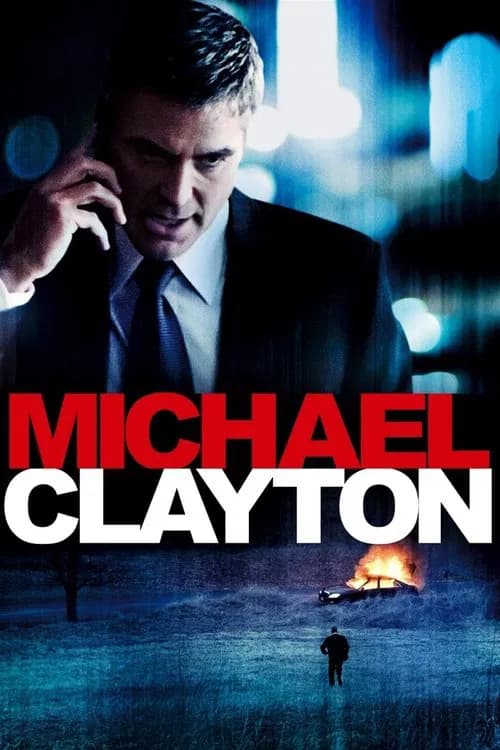
A law firm 'fixer' gets pulled into a corporate conspiracy when his colleague becomes a liability. The colleague is a brilliant attorney who has had a breakdown in the middle of a massive class action case against an agricultural chemical company. Tony Gilroy's legal thriller is about the moral cost of being good at your job in a corrupt system.
Michael Clayton is a 2007 drama and thriller film directed by Tony Gilroy. This breakdown covers 4 techniques (2 narrative, 1 editing and 1 psychology), each with the scene where you can see it. If you like how it is made, Zodiac uses several of the same techniques.
Starting the film by showing or telling you how it ends, such as the main character's death or defeat. The rest of the story then explains how things got there.
How this film uses it
Gilroy opens with Arthur's frantic voiceover, then jumps ahead to Michael's car exploding in a field. Michael has stepped out to look at some horses, so he survives. Then the film goes back 4 days. From there, the story works like an investigation in reverse, piecing together how Michael Clayton got to the moment we've already seen.
Where to see it
The explosion in the field. It comes in the opening minutes and you have no idea what it means. Everything after it explains whose car it was and why someone wanted him dead.
Cutting rapidly between fragments, threats and pressures, often with fast music and shifting camera angles. You feel the character's panic and the sense of being closed in from every side.
How this film uses it
Gilroy shows the corporation's surveillance operation through quick cuts between the investigators, the surveillance teams and the movements of Arthur and later Michael. In the montage, you see how far the conspiracy reaches. You start reading it as one system and stop reading it as a series of individual decisions.
Where to see it
The sequence where Karen Crowder's hired operatives bug Arthur's apartment and follow him. The film cuts between their surveillance and his movements. That lets you see the corporate conspiracy as a machine built for watching people.
Taking away, piece by piece, any way of telling truth from delusion. A character's whole understanding of events falls apart, and you end up just as lost.
How this film uses it
Michael discovers what Arthur knew and why the corporation needs him silenced. His role requires him to stay morally neutral, and once he knows this, he can't keep that up. The fixer can't fix the thing he has learned.
Where to see it
Michael finding Arthur's copy of Realm & Conquest with a copy shop receipt inside, then learning Arthur ordered 3,000 copies of the memo showing what the company knew about its weedkiller. After this information, he can't keep doing the job he has always done.
Watching events from a measured distance with no swelling music, tear-jerking close-ups or showy camera moves. The film trusts what happens to carry the weight on its own.
How this film uses it
Gilroy films Michael's skill at work and his failures at home from the same watchful distance (the midnight calls, the gambling debt, the son he barely sees). He trusts the details to pile up into a portrait. It's a portrait of a man whose moral choices have added up to a life he can't quite recognize.
Where to see it
Michael on the phone at 3 a.m., efficiently managing crises. You see how good he is at his job and what his personal life looks like at the same time. The film doesn't comment on the gap between them.
Questions
Michael Clayton: quick answers
What filmmaking techniques does Michael Clayton use?
CineCode breaks down 4 techniques in Michael Clayton (2007): Proleptic Opening, Paranoia Montage, Epistemic Collapse and Observational Restraint.
Who directed Michael Clayton?
Tony Gilroy directed Michael Clayton, released in 2007. CineCode also covers The Bourne Legacy (2012).
What films are similar to Michael Clayton?
Films that share techniques with Michael Clayton include Zodiac (2007), Aftersun (2022), Bugonia (2025), Goodfellas (1990).