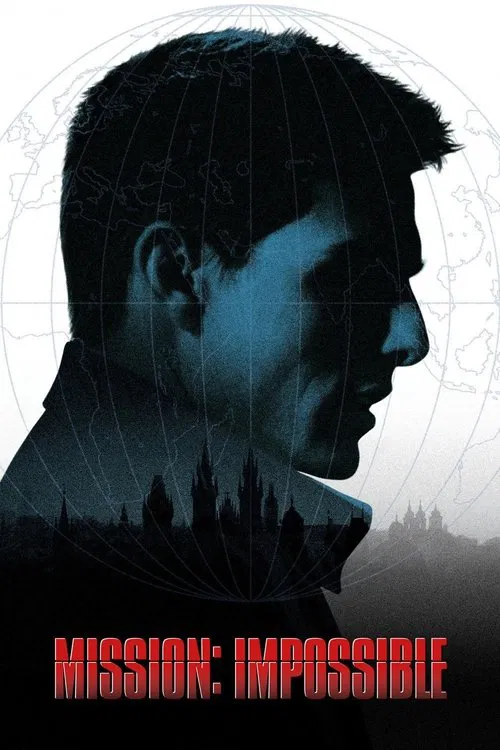
After a mission in Prague goes wrong, agent Ethan Hunt is the only survivor, and his own bosses think he is the traitor. He has to steal a secret list from the CIA and find the real mole. De Palma builds set pieces like puzzles, and this one has the most famous silent heist in action movies.
Mission: Impossible is a 1996 action, thriller and adventure film directed by Brian De Palma. This breakdown covers 4 techniques (2 narrative, 1 cinematography and 1 editing), each with the scene where you can see it. If you like how it is made, Star Wars: The Empire Strikes Back uses several of the same techniques.
Making an innocent person look guilty through coincidence and circumstantial evidence, while the audience knows or senses the truth. Everyday life turns dangerous because nobody believes them.
How this film uses it
After the Prague disaster, Ethan is the only survivor, so his own boss suspects him. He has to clear his name while hiding from his own agency. You know he is not the traitor, which makes each close call hurt more.
Where to see it
The debriefing. Ethan realizes the mission was a trap to find a mole, and he escapes the restaurant when his boss suspects him.
Staging a break-in as a quiet, precise routine where the audience learns the security rules and then watches one small slip threaten everything. Silence and stillness make a tiny movement feel huge.
How this film uses it
Ethan hangs from a cable above a sealed white room where noise and heat could set off alarms. There is almost no talk and no score. Every drop of sweat and every slow inch of the cable becomes a threat.
Where to see it
The Langley vault. Ethan is lowered on a rope into the CIA's computer room to steal the real agent list.
Saving a reveal for the climax that changes the meaning of every scene before it. You have to rebuild the whole film in your head with the new knowledge.
How this film uses it
Ethan has already guessed that Jim, his supposed mentor, is the mole and uses the train meeting to prove it. When Jim shows up alive, the story you followed up to then takes on a new meaning. The reveal makes the whole opening look like a setup.
Where to see it
The train. Ethan lets Jim reveal himself, and a live video of the betrayal goes to the IMF director.
Building an action sequence as a chain where each solution creates a new problem. The layout of the space stays clear, so the escalation follows its own logic.
How this film uses it
The finale on the TGV train is a chain of problems. Ethan fights Jim on the roof, a helicopter swings in, and each solution sets up the next danger. The train, the tunnel and the helicopter stay clear in space, so the escalation makes sense even at high speed.
Where to see it
The TGV climax. Ethan hooks the helicopter to the train and it is dragged into the Channel Tunnel.
Questions
Mission: Impossible: quick answers
What filmmaking techniques does Mission: Impossible use?
CineCode breaks down 4 techniques in Mission: Impossible (1996): Wrong Man Plot, Silent Heist Sequence, Retroactive Reframing Revelation and Kinetic Set Piece Architecture.
Who directed Mission: Impossible?
Brian De Palma directed Mission: Impossible, released in 1996. CineCode also covers Scarface (1983).
What films are similar to Mission: Impossible?
Films that share techniques with Mission: Impossible include Star Wars: The Empire Strikes Back (1980), The Matrix (1999), Raiders of the Lost Ark (1981), Oldboy (2003).