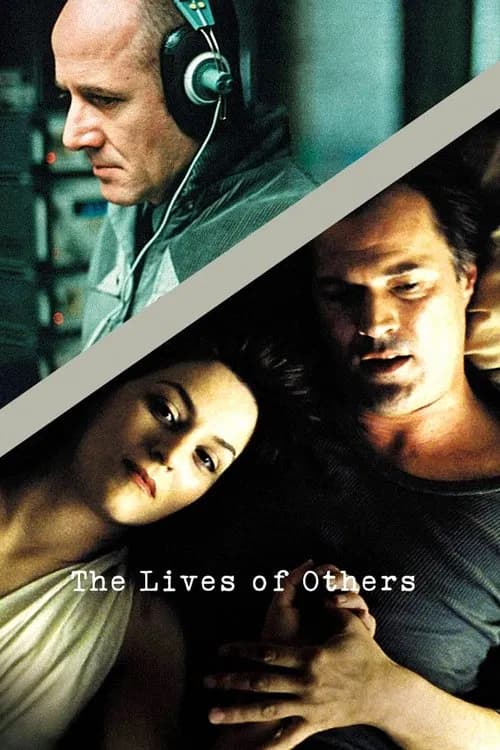
A dedicated East German Stasi officer is assigned to spy on a playwright and his actress girlfriend. What he hears slowly changes him, and he makes a secret choice that will cost him everything. The film is about how art can change even the people sent to destroy it.
The Lives of Others is a 2006 drama and thriller film directed by Florian Henckel von Donnersmarck. This breakdown covers 5 techniques (3 narrative, 1 cinematography and 1 editing), each with the scene where you can see it. If you like how it is made, Changeling uses several of the same techniques.
Showing a watcher who comes to know the person they spy on better than anyone in that person's life. The watching, through binoculars, long lenses or CCTV, becomes a closeness that changes the watcher.
How this film uses it
Wiesler sits in his attic listening post and gets to know Dreyman through his art, his love and his grief. He hears things the playwright's friends never hear. The surveillance is meant to produce evidence that will destroy Dreyman. It ends up producing understanding, and the officer can't bring himself to use what he knows.
Where to see it
Wiesler listening to Dreyman play the Sonata for a Good Man. From this moment, the surveillance becomes something else entirely.
Pulling the color out of the image and keeping it in cold grays and washed tones. The harsh, muted look makes a world feel sterile, drab or oppressive.
How this film uses it
Hagen Bogdanski's cinematography gives the GDR (East Germany) a Brechtian grey color palette. He took the look from his memory of the dark East Berlin streets of the period, where everything happened inside and in private. The film pretty much makes its argument through color, by setting the state's world against the artist's.
Where to see it
The Stasi headquarters. The gray buildings and lighting look like a system built to produce people like Wiesler.
Slowly shifting your attachment from the person being spied on to the officer doing the spying. The supposed villain becomes the film's real main character and its moral center.
How this film uses it
The film begins as Dreyman's story. By the midpoint, Wiesler has become its real subject, and his moral change is more dramatic than anything in the playwright's life. Von Donnersmarck does this by giving Wiesler the biggest choices and the fewest words. You have to read what he's feeling from how still he is.
Where to see it
Wiesler's first deliberate omission from a report. He leaves something out on purpose, and it's the first free choice the film's real protagonist makes.
Returning to the same physical object again and again until it means more than what it is. It moves the plot and also stands for the film's main ideas.
How this film uses it
The typewriter is the physical form of everything the state wants to destroy. It's the writer's secret voice, his hidden resistance and the 1 thing he keeps when everything else is monitored. If it were found, the film would end differently. It stays hidden because of Wiesler's choice.
Where to see it
The search of Dreyman's apartment. The typewriter is hidden under a floorboard, and the film's climax turns on whether it gets found.
Jumping ahead years after the story has resolved to show what became of a character. The whole story before it then reads as a look back at what was right and wrong.
How this film uses it
The film jumps ahead to after the fall of the Wall and shows Wiesler working as a letter carrier. He has been demoted, he's anonymous and he no longer has the identity the Stasi gave him. Then he reads the book Dreyman dedicated to him, 'HGW XX/7, in gratitude'. The epilogue shows that 1 man's secret act of conscience was seen, understood and honored.
Where to see it
The bookshop scene. Wiesler reads the dedication. When he's asked if the book is a gift, he answers 'No, it's for me'.
Questions
The Lives of Others: quick answers
What filmmaking techniques does The Lives of Others use?
CineCode breaks down 5 techniques in The Lives of Others (2006): Surveillance as Emotional Intimacy, Drained Color Look, Protagonist Ownership Transfer, Symbolic Object and Jump-Forward Epilogue.
Who directed The Lives of Others?
Florian Henckel von Donnersmarck directed The Lives of Others, released in 2006. CineCode also covers The Tourist (2010).
What films are similar to The Lives of Others?
Films that share techniques with The Lives of Others include Changeling (2008), The Shawshank Redemption (1994), Léon: The Professional (1994), Joker (2019).