Crime · Drama · Thriller

21 Grams

Alejandro González Iñárritu, 2003

A mathematician needing a new heart, a mother who has lost her family and an ex-convict who caused the accident are tied together by one hit-and-run. The film is told out of order and never lets you settle. Watch how color and time are used to keep three stories apart and together.

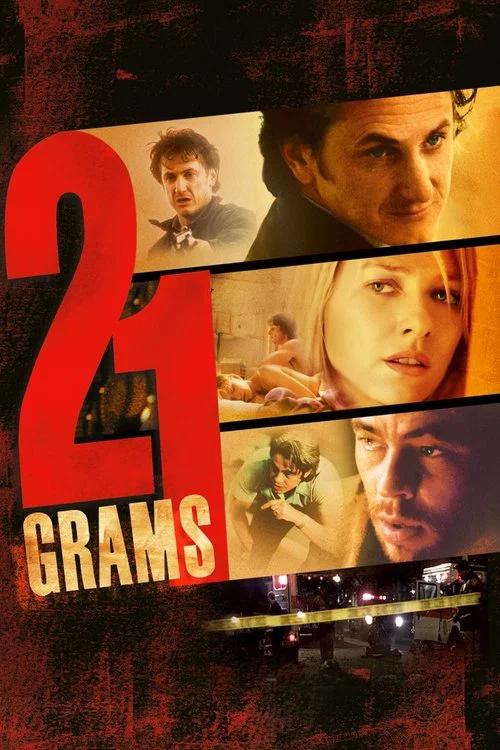
21 Grams (2003) poster

At a glance

21 Grams is a 2003 crime, drama and thriller film directed by Alejandro González Iñárritu. This breakdown covers 5 techniques (1 narrative, 1 editing, 2 cinematography and 1 psychology), each with the scene where you can see it. If you like how it is made, Moonlight uses several of the same techniques.

Narrative

Non-Linear Narrative

Telling the story out of order by jumping between time periods. The order you see events in changes how you understand them.

How this film uses it

The story is told in fragments, with each character's past, present and future threads mixed together. You see consequences before causes. The jumbled order makes you piece together how grief and guilt connect these three.

Where to see it

Scrambled order: the film is told in a nonlinear manner, and the three characters each have past, present and future threads that all come toward each other.

Editing

Three-Thread Parallel Cutting

Cutting between 3 or more storylines happening at the same time in different places. The pattern draws out shared themes and usually builds to a single combined climax.

How this film uses it

The film cuts between Paul, Cristina and Jack constantly. Each thread comments on the other two, and they build toward one combined crisis in a motel. You feel how one accident links three different lives.

Where to see it

Motel: Paul and Cristina check into the motel where Jack is staying. Paul leads Jack into a clearing at gunpoint but cannot kill him.

Cinematography

Color Symbolism

Giving specific colors to characters, groups or ideas and sticking to them through the film. Each time a color appears, it tells you something beyond what is shown.

How this film uses it

Cinematographer Rodrigo Prieto gave each story its own color. Paul's story uses cool colors, Jack's uses warm colors and Cristina's is neutral. The colors help you place the scene in the jumbled timeline.

Where to see it

Color coding: Paul's storyline is pictured in cool colors, Jack's in warm colors and Cristina's in neutral tones, with different film stocks used as things get more complex.

Cinematography

Handheld Cinema Vérité

Shooting with a handheld camera so the frame shakes and moves with the action. This documentary-style look, called cinema vérité, puts you uncomfortably close to the character.

How this film uses it

Gritty, hand-held shots keep the camera close to the characters. The picture shakes a little and the bleach bypass process drains the image. It feels like you are right there with them in their worst moments.

Where to see it

Hospital and motel scenes: the film's hand-held style puts you next to the characters when Paul shoots himself in the chest and is rushed to the hospital.

Psychology

Guilt as Hidden Motive

Letting a character's guilt over a past wrong shape what they do now. The wrong may come out late or only be hinted at, but it colors every choice.

How this film uses it

Jack is a man of faith, and his guilt after the accident drives everything he does. He confesses to the police even though his wife tells him to keep quiet. Later he asks Paul to kill him.

Where to see it

Jack's confession: Jack tells his wife that his duty is to God and turns himself in. He later begs Paul to actually kill him and end his misery.

Questions

21 Grams: quick answers

What filmmaking techniques does 21 Grams use?
CineCode breaks down 5 techniques in 21 Grams (2003): Non-Linear Narrative, Three-Thread Parallel Cutting, Color Symbolism, Handheld Cinema Vérité and Guilt as Hidden Motive.
Who directed 21 Grams?
Alejandro González Iñárritu directed 21 Grams, released in 2003. CineCode also covers Amores Perros (2000), Babel (2006), Biutiful (2010), Birdman or (The Unexpected Virtue of Ignorance) (2014), Digger (2026).
What films are similar to 21 Grams?
Films that share techniques with 21 Grams include Moonlight (2016), Amores Perros (2000), Following (1998), Polytechnique (2009).