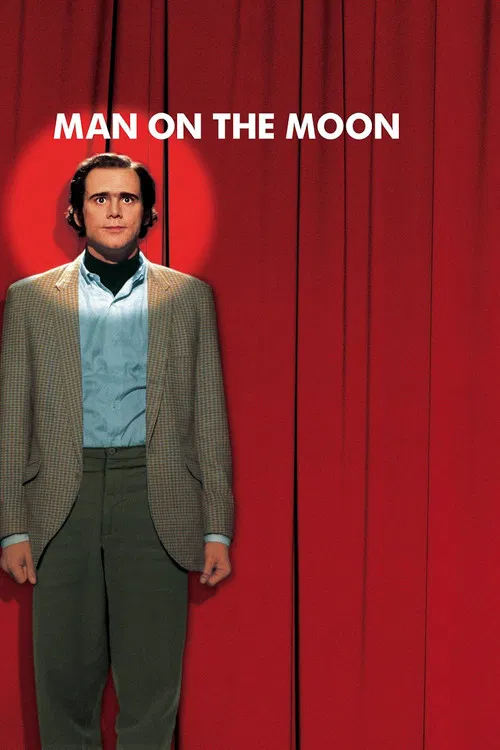
Comedian Andy Kaufman built his career on bits that left audiences unsure whether he was joking, from a shy foreign man to a rude lounge singer named Tony Clifton. Jim Carrey plays him. The film has the same job as Kaufman: it has to blur the line between real and fake.
Man on the Moon is a 1999 comedy, drama and biography film directed by Miloš Forman. This breakdown covers 5 techniques (3 narrative, 1 psychology and 1 sound), each with the scene where you can see it. If you like how it is made, F for Fake uses several of the same techniques.
Having a character look into the camera and speak to the audience, also called breaking the fourth wall. It makes you feel like their confidant and reminds you this is a film.
How this film uses it
Before the story starts, Carrey as Kaufman looks into the camera and tells you the movie is over, then plays the credits. It tells you the film will play games with you, the same way Kaufman did with his crowds.
Where to see it
The opening gag. A black and white Kaufman faces the camera, says the film has been cut short, and runs the closing credits.
Letting characters or stories cross the boundary between fiction and the real world inside the film. It plays with how much we rely on stories to cope with life.
How this film uses it
Kaufman stages a wrestling feud so well that TV viewers and even his own manager cannot tell where the act ends. Later he says he has lung cancer, and his friends assume it is another hoax. You end up doubting him too.
Where to see it
The Jerry Lawler feud. A staged rivalry with the wrestler leads to an apparent piledriver injury and a Letterman appearance that turns into insults and a fight.
Showing a character's sense of self being built, borrowed or stripped away by pressure, roles or the group. Who they are shifts with what they wear, say or join.
How this film uses it
Kaufman builds the Foreign Man, who becomes Latka on Taxi, then Elvis and Tony Clifton, and then struggles to be taken seriously as himself. Carrey stayed in character on and off set, which echoes how a role can swallow a person.
Where to see it
The Tony Clifton reveal. Kaufman introduces his manager to Clifton, a crude lounge singer who turns out to be Kaufman in disguise.
Embedding a play or musical inside the film, so the staged piece mirrors or comments on the characters' real lives.
How this film uses it
Many scenes are full stage acts, from the Foreign Man in the clubs to the Elvis impression. The shows mirror his private life, since each costume is a way of hiding. The last big show ends with a joke on and with the crowd.
Where to see it
The Carnegie Hall show. Kaufman plays Carnegie Hall, then invites the whole audience out for milk and cookies.
Building the soundtrack around a song written to honor the film's subject. The track gives the film its title and sets a tone of affection and wonder.
How this film uses it
R.E.M. wrote the soundtrack, and their 1992 song about Kaufman gave the film its title. The band's music frames him as someone people loved without fully understanding.
Where to see it
The funeral and epilogue. Mourners sing along to This Friendly World, and a year later Clifton performs at a tribute while Zmuda watches from the audience.
Questions
Man on the Moon: quick answers
What filmmaking techniques does Man on the Moon use?
CineCode breaks down 5 techniques in Man on the Moon (1999): Direct Address, Fiction Crossing Into Reality, Identity Construction and Loss, Staged Performance Within Film and Tribute Song as Theme.
Who directed Man on the Moon?
Miloš Forman directed Man on the Moon, released in 1999. CineCode also covers One Flew Over the Cuckoo's Nest (1975), Amadeus (1984).
What films are similar to Man on the Moon?
Films that share techniques with Man on the Moon include F for Fake (1973), Fight Club (1999), The Silence of the Lambs (1991), Amélie (2001).