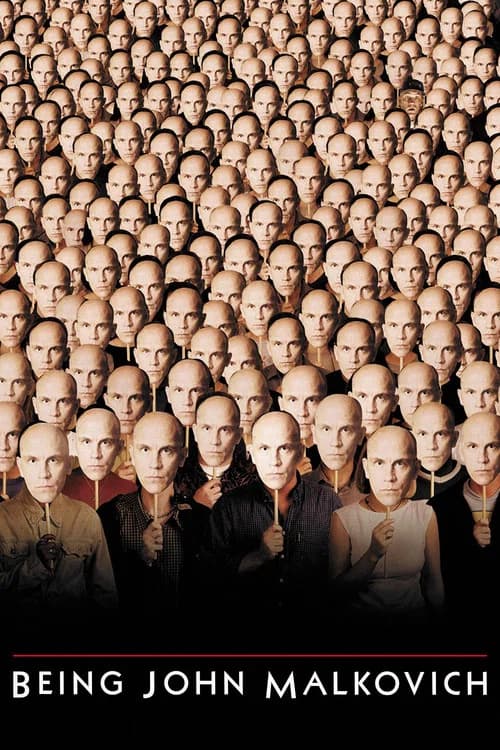
A puppeteer discovers a portal into the mind of actor John Malkovich and starts selling access by the quarter-hour. That sets off a comic spiral about identity, desire and the violence of living inside another person. Charlie Kaufman and Spike Jonze's film has the boldest debut premise in American cinema, and it fully earns it.
Being John Malkovich is a 1999 comedy, drama and fantasy film directed by Spike Jonze. This breakdown covers 5 techniques (3 narrative, 1 psychology and 1 cinematography), each with the scene where you can see it. If you like how it is made, Brazil uses several of the same techniques.
Taking a setup the audience thinks it knows and flipping it, such as a sequel turning the old villain into the protector. The film then follows the flipped idea with complete logic.
How this film uses it
The film presents the portal into Malkovich's mind with a completely straight face (bureaucratic forms, paid rides, a filing cabinet). It treats the impossible as a minor inconvenience.
Where to see it
The initial discovery scene in the Lester Corp filing room. The portal is treated as an ordinary thing to find at work.
Taking away, piece by piece, any way of telling truth from delusion. A character's whole understanding of events falls apart, and you end up just as lost.
How this film uses it
More and more people enter Malkovich, and eventually Malkovich enters himself. Step by step, the film takes away any firm sense of who anyone is. You stop being able to say whose mind is whose at any given moment.
Where to see it
The sequence where Malkovich enters the portal. He finds that everyone inside his mind is also Malkovich. It is a hall of mirrors with no original.
Arranging scenes the way a dream moves, where one image leads to the next by feeling or association. Events don't follow normal cause and effect.
How this film uses it
The rules change partway through: the portal extends, Malkovich can be controlled, a baby is chosen as a vessel. Each new twist follows its own strange logic, like a dream. Building a consistent world is fairly low on the film's list.
Where to see it
Lester's explanation that he hops from body to body and would be trapped in a newborn if he arrives late. The film plays it as a beat of dark comedy and horror.
Placing the camera where a character's eyes are, or shooting the scene the way that character experiences it. You see and feel things from inside their head.
How this film uses it
The portal sequences are filmed entirely from Malkovich's first-person view, so you see through his eyes. The image is blurry, distorted and only caught in glimpses. You become a voyeur inside a mind you can't fully get into.
Where to see it
Craig's first trip through the portal. He lives through Malkovich's cab ride and restaurant lunch in a close, cramped first-person view.
Giving a film 2 very different tones, such as comedy and tragedy, often split into halves. Each makes the other hit harder, and the film never blends them into 1.
How this film uses it
Being John Malkovich is hilarious and truly harrowing. When Craig exploits Malkovich's body, it is comedy and violation at the same time. Jonze never lets you settle into one mood.
Where to see it
The sex scene between Lotte-as-Malkovich and Maxine. It is wish-fulfillment, violation and absurd comedy all at once.
Questions
Being John Malkovich: quick answers
What filmmaking techniques does Being John Malkovich use?
CineCode breaks down 5 techniques in Being John Malkovich (1999): Premise Inversion, Epistemic Collapse, Dream Logic Structure, Subjective Camera and Tonal Bifurcation.
Who directed Being John Malkovich?
Spike Jonze directed Being John Malkovich, released in 1999. CineCode also covers Adaptation. (2002), Where the Wild Things Are (2009), Her (2013).
What films are similar to Being John Malkovich?
Films that share techniques with Being John Malkovich include Brazil (1985), Synecdoche, New York (2008), Room (2015), Rosemary's Baby (1968).