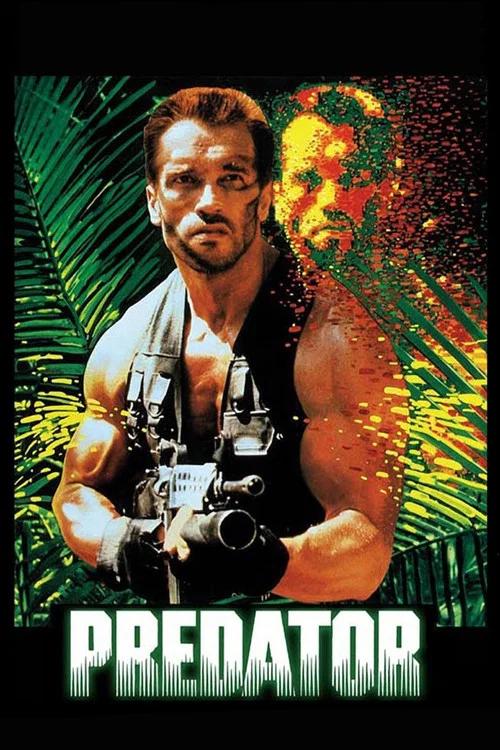
A team of commandos led by Dutch heads into the Central American jungle to rescue hostages, and finds something is hunting them one by one. McTiernan starts the film as a war movie and slowly turns it into a monster movie, and watching that shift is the fun part.
Predator is a 1987 action, science fiction and horror film directed by John McTiernan. This breakdown covers 5 techniques (2 narrative, 1 cinematography, 1 sound and 1 editing), each with the scene where you can see it. If you like how it is made, Halloween uses several of the same techniques.
Setting up a film to look like a familiar genre, then breaking that genre's rules on purpose. You have to rethink what kind of story you are watching.
How this film uses it
The film begins like a macho war movie, with big guns and a rescue mission. Then the team starts to die in silence, and the hunters become the hunted. The rules of the action film stop working.
Where to see it
The skinned bodies: the team finds soldiers hung high in the trees with their skin removed. The mood shifts from mission to dread.
Placing the camera where a character's eyes are, or shooting the scene the way that character experiences it. You see and feel things from inside their head.
How this film uses it
The film shows the creature's point of view through heat vision, with red and orange blobs for bodies. You see the soldiers the way the hunter does, which is cold and calculating.
Where to see it
The thermal view: the camera looks through the creature's mask at the team as glowing shapes while it stalks them from the trees.
Keeping a threat or character mostly out of view and suggesting it through sound, movement at the edge of the frame and other people's reactions. Your imagination makes it scarier than anything shown.
How this film uses it
For most of the film you never see the creature. You see branches shake, hear a clicking sound and watch the soldiers shoot at nothing, so your imagination fills in the monster.
Where to see it
The jungle barrage: after Blain is killed, Mac provokes the team into firing blindly into the jungle until trees fall, but they never see the creature.
Introducing a large cast only through what they say and do in the present. There are no flashbacks or explained histories, yet each character feels distinct.
How this film uses it
The soldiers are defined by how they speak, joke and fight. A tough greeting handshake, chewing tobacco and constant teasing tell you who each one is, and there are no flashbacks.
Where to see it
The greeting: Dutch and Dillon grab each other's arms in a muscle-flexing handshake. It shows their old Vietnam War bond without any explanation.
Building an action sequence as a chain where each solution creates a new problem. The layout of the space stays clear, so the escalation follows its own logic.
How this film uses it
The final fight is built from Dutch's traps in the jungle. Each one solves a problem and creates a new one, and the layout of the ground stays clear, so you can follow it.
Where to see it
The trap sequence: Dutch hides in mud to dodge the creature's heat vision and sets traps of logs and ropes, then lures the creature into them.
Questions
Predator: quick answers
What filmmaking techniques does Predator use?
CineCode breaks down 5 techniques in Predator (1987): Genre Subversion, Subjective Camera, Off-Screen Presence, Ensemble Characterization Without Backstory and Kinetic Set Piece Architecture.
Who directed Predator?
John McTiernan directed Predator, released in 1987. CineCode also covers Die Hard (1988).
What films are similar to Predator?
Films that share techniques with Predator include Halloween (1978), Parasite (2019), Eternal Sunshine of the Spotless Mind (2004), 12 Angry Men (1957).