War · Drama · Sport

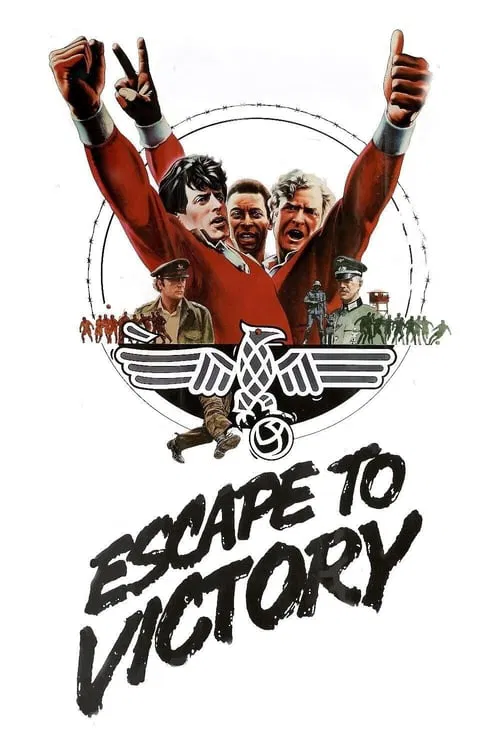
Escape to Victory

John Huston, 1981

Allied prisoners of war in a German camp are asked to play an exhibition football match against a German side, which turns out to be a propaganda stunt. The Resistance plans an escape through a tunnel to the stadium. Worth watching for how the film stages a real football match with real footballers.

Escape to Victory (1981) poster

At a glance

Escape to Victory is a 1981 war, drama and sport film directed by John Huston. This breakdown covers 5 techniques (3 narrative, 1 cinematography and 1 sound), each with the scene where you can see it. If you like how it is made, The Wild Child uses several of the same techniques.

Narrative

Sports Match as Climax

Building the whole third act around one game, so the score, the fouls and the crowd carry the suspense. Every play counts for something beyond the sport.

How this film uses it

The final match is played in full, with a biased referee, rough fouls and a disallowed Allied goal. A game is easy to follow, so you always know what is at stake. The 4-4 score and the last-second penalty save turn the match into the plot.

Where to see it

The second half at Colombes Stadium: the referee lets German fouls slide, the Allies are denied a fair goal, and the match ends 4-4 with a penalty save at the final whistle.

Narrative

Redefined Victory

Changing what counts as winning partway through the story, so the hero chases a smaller, personal goal. The ending can then feel like a triumph even when the hero loses.

How this film uses it

At halftime the team is losing 4-1, and the tunnel to freedom has just opened up in their dressing room. They could leave right then. They decide to go back out and finish the game, so a draw becomes a win of its own.

Where to see it

The halftime dressing room: the Resistance tunnelers break through, and the players persuade Hatch to come back to the pitch instead of escaping.

Narrative

Non-Professional Cast Authenticity

Casting real people from the community being shown, such as workers and local residents, with no trained actors in those roles. Their looks and behavior feel true in a way acting can't copy.

How this film uses it

Much of the Allied team is played by real footballers, including Pelé, Bobby Moore and Osvaldo Ardiles. Pelé was also credited with designing the set plays. The football on screen has real skill in it that actors could not fake.

Where to see it

The match at Colombes: the Allied side is full of real professional players who handle the ball like they do on the pitch.

Cinematography

Location Stand-In

Shooting a scene in one place and dressing it to pass for another, such as a stadium that stands in for an embassy. You accept the fiction as long as the details look right.

How this film uses it

The production shot in and around Budapest to stand in for Paris and occupied France. The match was filmed at the old MTK Stadium, chosen partly because it had no floodlights, which were rare in the 1940s. The stadium looks old because it was old.

Where to see it

The match at Colombes Stadium: the crowd, the old stands and the lack of floodlights all come from a real Budapest ground.

Sound

Classical Music as Score

Using existing classical pieces as the soundtrack, with no newly composed score. The music brings its own history, cultural weight and emotion into the film.

How this film uses it

Bill Conti's score leans heavily on Shostakovich's Symphony No. 7 and nearly quotes its march theme. The ending draws on Shostakovich's Symphony No. 5. The music tells you straight away that this is a story about people under occupation who will not break.

Where to see it

The pitch invasion: the crowd storms the field at the final whistle, helps the players blend in, and they walk out through the gates.

Questions

Escape to Victory: quick answers

What filmmaking techniques does Escape to Victory use?
CineCode breaks down 5 techniques in Escape to Victory (1981): Sports Match as Climax, Redefined Victory, Non-Professional Cast Authenticity, Location Stand-In and Classical Music as Score.
Who directed Escape to Victory?
John Huston directed Escape to Victory, released in 1981. CineCode also covers The Maltese Falcon (1941), The Treasure of the Sierra Madre (1948), Key Largo (1948), The Asphalt Jungle (1950), The African Queen (1951), Moby Dick (1956).
What films are similar to Escape to Victory?
Films that share techniques with Escape to Victory include The Wild Child (1970), The Rider (2018), City of God (2002), 2001: A Space Odyssey (1968).