Fantasy · Adventure · Family

Hook

Steven Spielberg, 1991

Peter Banning is a workaholic lawyer who ignores his kids. When Captain Hook kidnaps them, he learns he was once Peter Pan and has to return to Neverland. The film draws on Spielberg's own feelings about childhood and his father. Watch how the sets build a world.

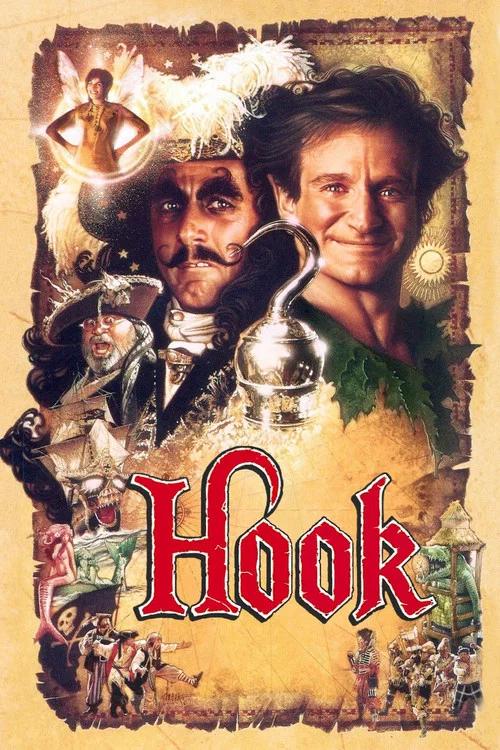
Hook (1991) poster

At a glance

Hook is a 1991 fantasy, adventure and family film directed by Steven Spielberg. This breakdown covers 4 techniques (1 cinematography, 2 narrative and 1 psychology), each with the scene where you can see it. If you like how it is made, Boyhood uses several of the same techniques.

Cinematography

Set as Total World

Building a set so complete, with its own weather, crowds, architecture and social rules, that it feels lived in. It reads as real until one deliberate slip shows that it was built.

How this film uses it

Filming took place mainly on nine sound stages at Sony Pictures Studios. Neverland is a built set, and it feels complete. The look is storybook, and it works as a world you can believe in.

Where to see it

The Neverland scenes. Hook's pirates and the Lost Boys live in sets built on sound stages.

Narrative

Autobiographical Distance

Drawing on the filmmaker's own life but keeping it at arm's length, often through a fictional stand-in. The result is precise and unsentimental, and it can question how memory flatters us.

How this film uses it

Spielberg has said the film draws on his own feelings about childhood and his relationship with his father. He puts those feelings into Peter, a father who is too busy for his kids. One reading is that Peter is a stand-in for the filmmaker's worries.

Where to see it

The early scenes with Peter and his kids. Jack is hurt by his father's broken promises.

Narrative

Character Arc Inversion

Taking a character to the opposite of where they started, such as from weak to strong or from decent to compromised. That reversal is what the film is about.

How this film uses it

Peter starts as a man who has forgotten how to play and ends as a father who flies again. The film moves him to the opposite of where he began. That change is what the story is about.

Where to see it

The final battle. Peter has regained his memories and powers, and Jack reconciles with him.

Psychology

Dream Imagery as Inner Life

Staging dreams, fantasies and imagination as literal scenes. The inner mind becomes visible, whether as wish, fear or creative power.

How this film uses it

Peter has forgotten how to fly, and the Lost Boys train him to reconnect with his imagination. His power comes back when he believes again. The idea that belief makes you strong is part of the film's logic.

Where to see it

The Lost Boys' training. Rufio and the boys help Peter rediscover his imagination.

Questions

Hook: quick answers

What filmmaking techniques does Hook use?
CineCode breaks down 4 techniques in Hook (1991): Set as Total World, Autobiographical Distance, Character Arc Inversion and Dream Imagery as Inner Life.
Who directed Hook?
Steven Spielberg directed Hook, released in 1991. CineCode also covers Duel (1971), Jaws (1975), Close Encounters of the Third Kind (1977), 1941 (1979), Raiders of the Lost Ark (1981), E.T. the Extra-Terrestrial (1982).
What films are similar to Hook?
Films that share techniques with Hook include Boyhood (2014), A Complete Unknown (2024), Mirror (1975), The Magnificent Ambersons (1942).