Drama · Crime

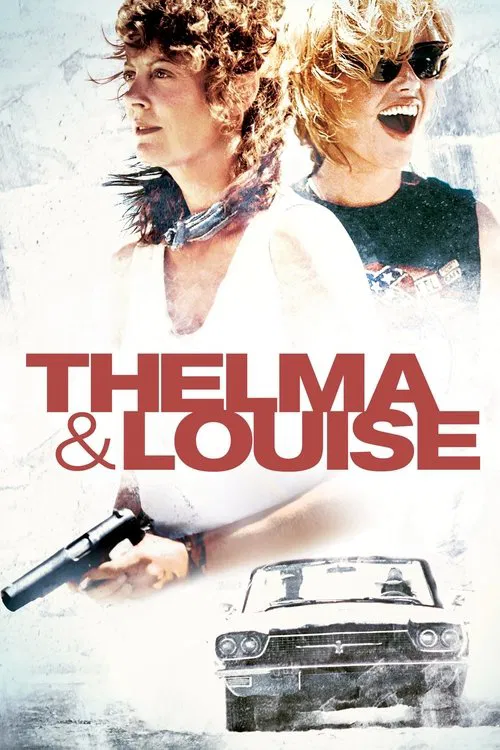
Thelma & Louise

Ridley Scott, 1991

Two friends take a weekend road trip that turns into a run from the law after one of them shoots a man who attacked the other. The trip changes both women. Watch how the film uses wide Western landscapes, a chain of worsening choices and one famous last image.

Thelma & Louise (1991) poster

At a glance

Thelma & Louise is a 1991 drama and crime film directed by Ridley Scott. This breakdown covers 5 techniques (3 narrative, 1 editing and 1 cinematography), each with the scene where you can see it. If you like how it is made, The Treasure of the Sierra Madre uses several of the same techniques.

Narrative

Character Arc Inversion

Taking a character to the opposite of where they started, such as from weak to strong or from decent to compromised. That reversal is what the film is about.

How this film uses it

Thelma starts as a timid housewife who is too nervous to ask her husband for a weekend away, so she leaves him a note. By the end of the trip she is the one making plans. After J.D. steals Louise's savings, Thelma takes charge and robs a store herself. Louise, who began the trip in control, becomes the one who is shaken.

Where to see it

The convenience store robbery: after J.D. takes Louise's money and disappears, Thelma robs a nearby store using what he taught her.
Narrative

Escalating Moral Stakes

Raising the ethical price of winning with each part of the story. Every compromise the characters make leads to a worse one, until they can't go back.

How this film uses it

Each choice costs the women more. Louise shoots Harlan in a fit of rage, so they run. The store robbery makes them wanted for armed theft. Then they lock a state trooper in his trunk and blow up a fuel tanker. After the first mistake, every way out looks worse than the one before.

Where to see it

The fuel tanker: a foul-mouthed truck driver keeps making obscene gestures at them. When he refuses to apologize, they shoot at his tanker and it explodes.

Narrative

Redefined Victory

Changing what counts as winning partway through the story, so the hero chases a smaller, personal goal. The ending can then feel like a triumph even when the hero loses.

How this film uses it

Early on, winning means reaching Mexico. When the women are cornered near the edge of the Grand Canyon, Thelma suggests they "keep going." The goal has changed. Staying free matters more to them than staying alive. The ending can read as a triumph even though they lose everything else.

Where to see it

The canyon edge: the police close in and Hal begs them to stop. The women kiss, hold hands and drive off the cliff.

Editing

Freeze Frame Punctuation

Stopping the picture on a single still frame for a moment. It works like punctuation to introduce a character, underline a joke or mark a turning point.

How this film uses it

The film ends by stopping the picture on the car in the air above the canyon, then fading out. You never see it land. The frozen image holds the women at the high point of their escape and leaves what happens next to you.

Where to see it

The final shot: the Thunderbird leaves the cliff and the image freezes in mid-air.

Cinematography

Landscape as Sacred Geography

Photographing real landscapes like mountains, plains and rivers so they feel mythic and full of meaning. The land becomes a spiritual and moral test the characters have to cross.

How this film uses it

The story is set on a route from Arkansas to the Grand Canyon, though most of it was shot in California and Utah. Open desert, red rock and long straight roads give the trip a mythic feel. The canyon at the end works like a final test, and the women face it on their own terms. This is one way to read it.

Where to see it

The final chase: after the FBI finds them, the women lead police on a high-speed run through the desert until they are cornered about 100 yards from the Grand Canyon.

Questions

Thelma & Louise: quick answers

What filmmaking techniques does Thelma & Louise use?
CineCode breaks down 5 techniques in Thelma & Louise (1991): Character Arc Inversion, Escalating Moral Stakes, Redefined Victory, Freeze Frame Punctuation and Landscape as Sacred Geography.
Who directed Thelma & Louise?
Ridley Scott directed Thelma & Louise, released in 1991. CineCode also covers The Duellists (1977), Alien (1979), Blade Runner (1982), Legend (1985), Black Rain (1989), 1492: Conquest of Paradise (1992).
What films are similar to Thelma & Louise?
Films that share techniques with Thelma & Louise include The Treasure of the Sierra Madre (1948), 1492: Conquest of Paradise (1992), The Beach (2000), Silence (2016).