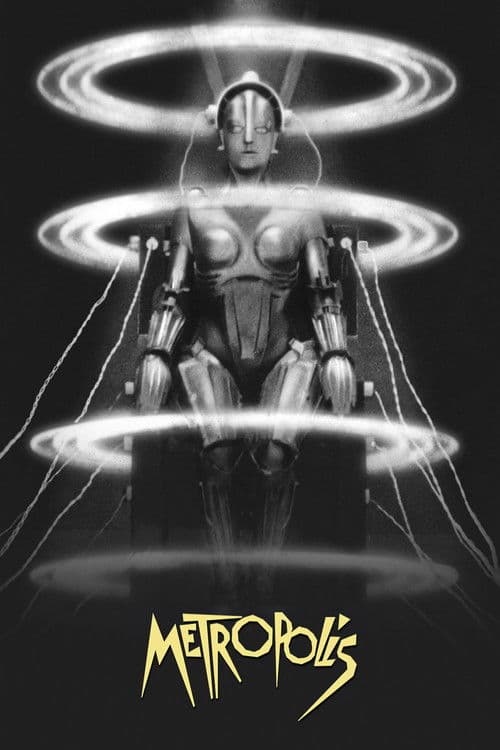
Metropolis
Fritz Lang · 1927
In a vast future city, the privileged ruling class lives above ground while workers labor in underground machinery, until the son of the city's master falls in love with a worker-prophet and discovers what lies beneath. Fritz Lang's silent masterpiece invented the visual language of science fiction cinema and encoded within it a political argument that has never stopped being relevant.
Techniques Used
5 techniques identified in this film
Architectural Class Opposition
NarrativeUsing the built environment — its vertical organization, its material quality, its relationship to light — to make a social argument about class hierarchy, encoding power relations in physical space.
How this film uses it
Lang divides the city vertically: the ruling class occupies towers of glass and light above, workers operate the machines in underground darkness below. The architecture is the film's political argument made in steel and shadow — social structure rendered as physical structure, class as geography.
Silent Film Performance Register
CinematographyThe heightened physical expressivity of silent-era performance — where body language, facial expression, and gesture must carry emotional content that sound film assigns to dialogue.
How this film uses it
Brigitte Helm's double performance — as Maria the prophet and as the false Maria the robot — operates through the expressionist body language of the silent era. The robot's mechanical movements and the prophet's saintly stillness are differentiated entirely through physicality, the performance achieving what sound would merely approximate.
Practical Miniature Construction
CinematographyBuilding scale models of environments too large or impossible to construct at full scale — filming them with techniques that integrate the miniature convincingly with full-scale elements.
How this film uses it
The towers of Metropolis were built as scale miniatures and integrated with full-scale human action through the Schüfftan process — a mirror technique that reflected miniature images into the live camera frame. The result was a city of convincing scale that could not have existed otherwise.
Ideological Villain
NarrativeAn antagonist whose menace derives not from conventional evil but from the complete internalization of a system's logic — dangerous not through malice but through the total absence of any value outside the system's own terms.
How this film uses it
Joh Fredersen governs Metropolis through information suppression, surveillance, and the engineering of worker passivity. His methods are not sadistic but managerial — he is not cruel to the workers, he simply does not register them as people whose experience matters. His ideology is the ideology of efficiency without ethics.
Production Design as Psychological Space
CinematographyUsing a film's sets and design to externalize character psychology — so that the space a person inhabits tells the audience what the dialogue cannot.
How this film uses it
Every space in Metropolis communicates its occupants' psychological condition: the workers' underground is a machine world that has made workers into components; the Eternal Gardens above are a pleasure space that has made the ruling class into children; Rotwang's house is a medieval alchemist's den transplanted into a modern city, externalizing his madness.
You Might Also Like
Films that share at least one technique with Metropolis

In a Britain ravaged by the Rage virus, a young survivor is captured by a roving Satanic cult while a scientist makes an unprecedented connection with an infected host. Written by Alex Garland, directed by Nia DaCosta — a sequel that deliberately dismantles the visual grammar of its predecessor.
28 Years Later: The Bone Temple
Nia DaCosta · 2026

Batman faces the Joker, a chaos agent who makes no demands and cannot be bargained with, while Harvey Dent's crusade against organized crime ends in catastrophic personal failure. A superhero film that functions as a post-9/11 interrogation of the cost of moral compromise.
The Dark Knight
Christopher Nolan · 2008

A hobbit from the Shire inherits a ring of terrible power and sets out with eight companions to destroy it before it can be reclaimed by the dark lord Sauron. A world-building epic that earns its mythology through texture, scale, and the specificity of its characters.
The Lord of the Rings: The Fellowship of the Ring
Peter Jackson · 2001