Drama · Crime

Rumble Fish

Francis Ford Coppola, 1983

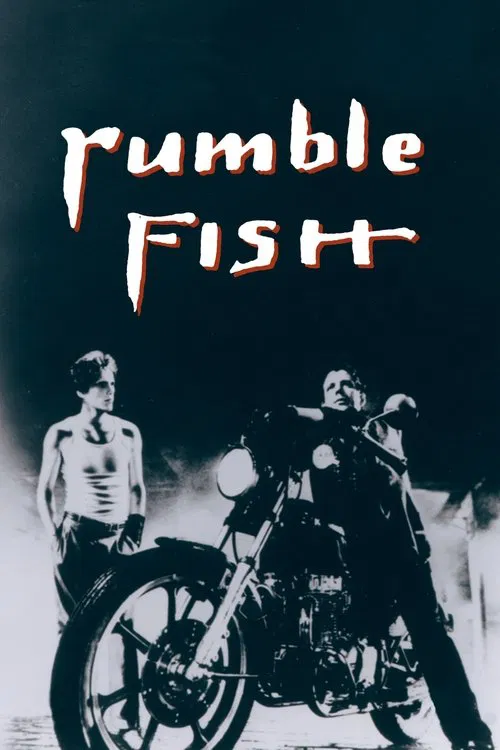
Rusty James, a Tulsa teenager, worships his older brother, the Motorcycle Boy, who once united the local gangs and then disappeared. When he returns, the street life around them starts to fall apart. Coppola shot it right after The Outsiders, and it looks like an old German silent movie with an experimental drum score.

Rumble Fish (1983) poster

At a glance

Rumble Fish is a 1983 drama and crime film directed by Francis Ford Coppola. This breakdown covers 4 techniques (1 cinematography, 1 psychology, 1 narrative and 1 sound), each with the scene where you can see it. If you like how it is made, Sanjuro uses several of the same techniques.

Cinematography

Isolated Color Insert

Adding 1 colored element to an otherwise black-and-white image, or a brief color sequence to a black-and-white film. The contrast pulls your eye and gives that color a lot of meaning.

How this film uses it

The film is almost entirely black and white, except for the Siamese fighting fish. Coppola's cinematographer Stephen Burum shot the actors in black and white, then rear-projected that footage behind a color fish tank. The fish become the only living color in a grey world.

Where to see it

The pet store. Rusty James becomes fascinated with the fighting fish, the film's only source of color.
Psychology

Psychological Doubling

Pairing the main character with a second character who mirrors them. The double shows what the hero wants, fears or secretly is.

How this film uses it

Rusty James tries to become his brother, and the Motorcycle Boy is who he could turn into. The older brother is calm and distant, and Rusty James is hot-tempered. The pairing shows what Rusty wants, and what it would cost him.

Where to see it

Rusty James and the Motorcycle Boy. The Motorcycle Boy tries to get his younger brother out of gang life, and Rusty starts to believe those who call him insane.

Narrative

Symbolic Object

Returning to the same physical object again and again until it means more than what it is. It moves the plot and also stands for the film's main ideas.

How this film uses it

Clocks keep appearing, along with time-lapse clouds racing across the sky. They tell you time is passing faster than the characters realize. The images tie every scene to the idea of lost time.

Where to see it

The clocks and the sky. Clocks and fast-moving clouds recur between scenes, setting a ticking pace.

Sound

Tension Motif Score

Scoring with persistent patterns, such as insistent percussion or circling phrases that never resolve. The music keeps tension high even in quiet moments.

How this film uses it

Stewart Copeland, drummer of The Police, wrote a largely percussive score and mixed in recordings of Tulsa street sounds. The beat sounds like a clock that won't stop. It adds anxiety to scenes that would otherwise just be talk.

Where to see it

Rusty James on the Tulsa streets. The drumming and city sounds run under his walks and fights.

Questions

Rumble Fish: quick answers

What filmmaking techniques does Rumble Fish use?
CineCode breaks down 4 techniques in Rumble Fish (1983): Isolated Color Insert, Psychological Doubling, Symbolic Object and Tension Motif Score.
Who directed Rumble Fish?
Francis Ford Coppola directed Rumble Fish, released in 1983. CineCode also covers The Godfather (1972), The Godfather Part II (1974), The Conversation (1974), Apocalypse Now (1979), The Outsiders (1983), Peggy Sue Got Married (1986).
What films are similar to Rumble Fish?
Films that share techniques with Rumble Fish include Sanjuro (1962), Enemy (2014), Stoker (2013), The Double Life of Véronique (1991).