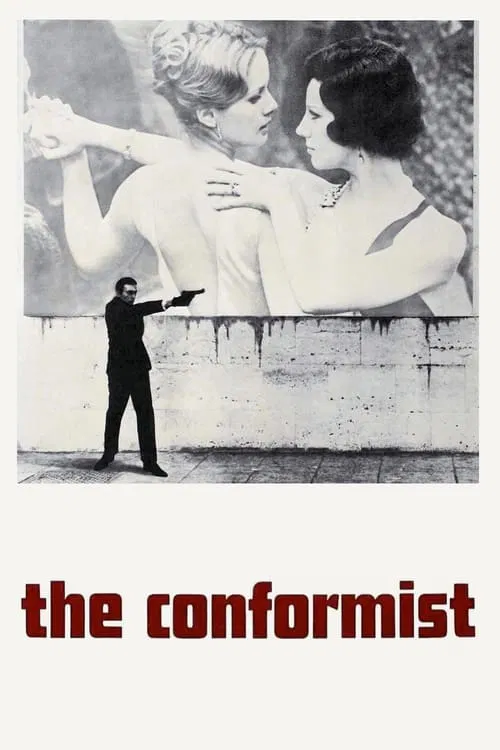
A middle-class Italian man agrees to assassinate his former professor, now an anti-Fascist exile in Paris. He does it to lock in his place as a conformist within Mussolini's regime. His own repressed homosexuality and childhood trauma complicate every step of his obedience. Bernardo Bertolucci and cinematographer Vittorio Storaro made one of cinema's most visually gorgeous accounts of political cowardice.
The Conformist is a 1970 drama and thriller film directed by Bernardo Bertolucci. This breakdown covers 5 techniques (2 narrative, 2 cinematography and 1 psychology), each with the scene where you can see it. If you like how it is made, Amadeus uses several of the same techniques.
Telling the story out of order by jumping between time periods. The order you see events in changes how you understand them.
How this film uses it
The film moves freely between Marcello's present journey to Paris and the childhood trauma that drives it. He has pushed the past down, so it comes up out of order and in pieces as the mission gets closer.
Where to see it
The childhood flashback of Lino's assault. It bursts into the present story without warning, so the memory hits like an ambush.
Lighting a scene with strong contrast between bright light and deep shadow, a style borrowed from old paintings called chiaroscuro. How lit a character is hints at their moral or mental state.
How this film uses it
Storaro's lighting makes the film's moral case in pictures. He uses chiaroscuro, which means strong contrast between light and dark. Fascism gets deep geometric shadows and cold institutional light, while the political exiles in Paris get warmer, less clear-cut tones.
Where to see it
The dance hall sequence in Paris. Shafts of light cut through smoke and shadow, and the political and sexual tension turns into pure shapes of light and dark.
Pairing the main character with a second character who mirrors them. The double shows what the hero wants, fears or secretly is.
How this film uses it
Marcello's professor Quadri is his double. He is what Marcello might have become had he chosen conscience over conformity. That makes the assassination a kind of self-murder.
Where to see it
The debate in Quadri's Paris apartment. Marcello and Quadri argue about fascism. The shot is composed to show how alike they look and how far apart their beliefs are.
Using the full width of a very wide 2.35:1 frame to set small human figures against huge, empty landscapes. All that empty space makes the characters look isolated and insignificant.
How this film uses it
Storaro and Bertolucci use the wide frame to put Marcello at the edge of spaces that are too large for him, with fascist architecture dwarfing the individual. Once again, the picture makes the point: to conform, you have to erase yourself.
Where to see it
The Italian Ministry sequence. Marcello is framed in one corner of a vast marble hall. The empty space between him and power measures how much he has compromised.
Starting the film by showing or telling you how it ends, such as the main character's death or defeat. The rest of the story then explains how things got there.
How this film uses it
The film opens with Marcello in a Paris hotel room in 1938, as he prepares for the assassination. As he is driven to the killing, it goes back into the past to explain how he got there. The ending is the starting point.
Where to see it
The opening hotel room scene. Marcello prepares for the killing while his wife waits, so the moral cost is already set in motion before the film explains it.
Questions
The Conformist: quick answers
What filmmaking techniques does The Conformist use?
CineCode breaks down 5 techniques in The Conformist (1970): Non-Linear Narrative, Chiaroscuro Lighting, Psychological Doubling, Anamorphic Scope Composition and Proleptic Opening.
Who directed The Conformist?
Bernardo Bertolucci directed The Conformist, released in 1970. CineCode also covers The Dreamers (2003).
What films are similar to The Conformist?
Films that share techniques with The Conformist include Amadeus (1984), Citizen Kane (1941), Persona (1966), Eyes Wide Shut (1999).