Crime · Thriller · Drama

Cassandra's Dream

Woody Allen, 2007

Two London brothers in money trouble ask their rich uncle for help, and he asks for a murder in return. They agree, and guilt starts to pull them apart. Worth watching for how a small sailboat and a repeating score turn a family favor into a slow tragedy.

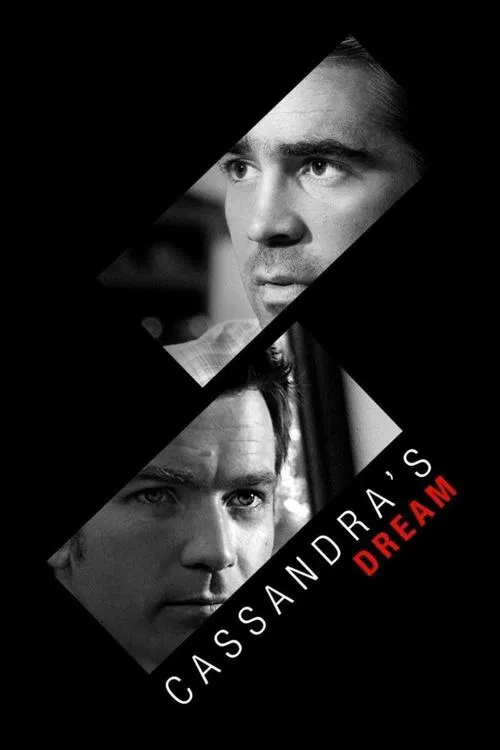
Cassandra's Dream (2007) poster

At a glance

Cassandra's Dream is a 2007 crime, thriller and drama film directed by Woody Allen. This breakdown covers 4 techniques (2 narrative, 1 sound and 1 psychology), each with the scene where you can see it. If you like how it is made, The Treasure of the Sierra Madre uses several of the same techniques.

Narrative

Escalating Moral Stakes

Raising the ethical price of winning with each part of the story. Every compromise the characters make leads to a worse one, until they can't go back.

How this film uses it

The brothers begin by wanting money for a new life, then agree to kill Howard's former partner. After the murder, Ian goes further and agrees with Howard that Terry has to go too. Each step costs more than the last, and there is no way back.

Where to see it

The plan to kill Terry. Ian takes Howard's advice that there is no other choice and prepares to poison his own brother on the boat.

Narrative

Symbolic Object

Returning to the same physical object again and again until it means more than what it is. It moves the plot and also stands for the film's main ideas.

How this film uses it

The boat is named Cassandra's Dream after the greyhound that won Terry the money to buy it. It starts as a sign of hope for the brothers. It stays in beautiful condition while everything on board goes wrong, and it is found drifting at the end.

Where to see it

The boat's discovery. The police find Cassandra's Dream adrift and still in beautiful condition, and decide Terry killed Ian and drowned himself.

Sound

Minimalist Score

Scoring with repeating, slowly shifting patterns that build a calm, trance-like mood. The music feels like part of a ritual.

How this film uses it

Philip Glass wrote the score, the first original one on a Woody Allen film in decades. His repeating figures sit under the plotting and the aftermath. The music gives a family story the weight of doom.

Where to see it

The days after the murder. The score plays as Terry sinks into guilt while Ian tries to carry on.

Psychology

Guilt as Hidden Motive

Letting a character's guilt over a past wrong shape what they do now. The wrong may come out late or only be hinted at, but it colors every choice.

How this film uses it

After the murder, Ian wants to move on, and Terry turns to alcohol and drugs and scares his fiancee. Terry says he wants to turn himself in. Two brothers who did the same act end up in very different places, and that gap drives the ending.

Where to see it

Terry's breakdown. His fiancee tells Ian that Terry believes he has killed someone, and Terry says he wants to go to the police.

Questions

Cassandra's Dream: quick answers

What filmmaking techniques does Cassandra's Dream use?
CineCode breaks down 4 techniques in Cassandra's Dream (2007): Escalating Moral Stakes, Symbolic Object, Minimalist Score and Guilt as Hidden Motive.
Who directed Cassandra's Dream?
Woody Allen directed Cassandra's Dream, released in 2007. CineCode also covers Take the Money and Run (1969), Bananas (1971), Everything You Always Wanted to Know About Sex *But Were Afraid to Ask (1972), Sleeper (1973), Love and Death (1975), Annie Hall (1977).
What films are similar to Cassandra's Dream?
Films that share techniques with Cassandra's Dream include The Treasure of the Sierra Madre (1948), Yesterday (2019), Silence (2016), Match Point (2005).