Science Fiction · Adventure

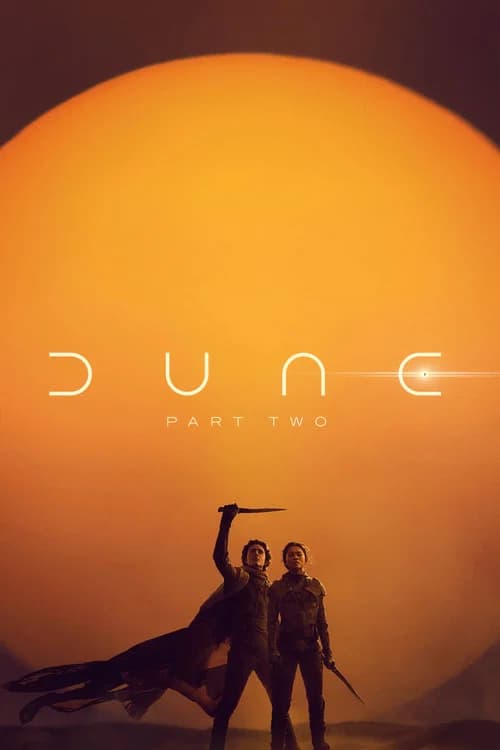
Dune: Part Two

Denis Villeneuve, 2024

Paul Atreides fully embraces his role among the Fremen and rides the sandworms of Arrakis. However, the Bene Gesserit planted a prophecy, and as he rises into it he speeds toward a holy war he knows he can't stop. Villeneuve's conclusion is a film about the horror of becoming a messiah.

Dune: Part Two (2024) poster

At a glance

Dune: Part Two is a 2024 science fiction and adventure film directed by Denis Villeneuve. This breakdown covers 4 techniques (2 cinematography, 1 narrative and 1 sound), each with the scene where you can see it. If you like how it is made, Dune: Part One uses several of the same techniques.

Cinematography

Desert as Protagonist

Treating a desert or vast landscape as a main character with as much screen time as the actors. It has its own arc and can dwarf, kill and transform the people in it.

How this film uses it

The second film makes Arrakis feel even more like a living system. The sandworms, the spice and the weather all act on the story. By the end, the desert is as much a character as Paul or Chani.

Where to see it

Paul riding his first sandworm. You can't tell the creature from the dune, and Paul is impossibly small on a living mountain of sand.

Cinematography

IMAX Large-Format Space

Shooting vast environments, including outer space, on 70mm IMAX film. The extra size and sharpness make you feel like you are inside the image.

How this film uses it

Greig Fraser shot the Harkonnen homeworld sequences in black and white with an infrared digital camera. In IMAX, they look completely different from Arrakis. The huge format is put to work on industrial horror.

Where to see it

The Harkonnen gladiatorial arena sequence. It is shot in infrared black-and-white IMAX. The crowd is one faceless mass, and the violence has no color or humanity left in it.

Narrative

Monomyth Blueprint

Structuring the story on the classic hero's journey, with its call to adventure, trials, ordeal and return home. The pattern feels familiar because myths in many cultures share it.

How this film uses it

Paul completes the monomyth, the classic hero's journey, and Villeneuve makes that the tragedy of the film. The journey arrives exactly where it was always going. That place is the start of a jihad that will kill billions.

Where to see it

Paul accepting the messianic title and calling the Fremen to holy war. This would be the triumphant climax of a hero's journey, and the film shows it as a catastrophe.

Sound

Leitmotif

Repeating a short piece of music or a sound every time a certain character, idea or feeling comes up. You learn to connect the 2.

How this film uses it

Hans Zimmer expands the musical themes he gave the Fremen and the Bene Gesserit in Part One. As Paul's transformation completes, the Fremen's drumming and throat singing swell into something close to war music.

Where to see it

The Fremen rallying cry, scored with Zimmer's percussion at its full, terrifying scale. The music that sounded mysterious in Part One now turns out to be military.

Questions

Dune: Part Two: quick answers

What filmmaking techniques does Dune: Part Two use?
CineCode breaks down 4 techniques in Dune: Part Two (2024): Desert as Protagonist, IMAX Large-Format Space, Monomyth Blueprint and Leitmotif.
Who directed Dune: Part Two?
Denis Villeneuve directed Dune: Part Two, released in 2024. CineCode also covers Polytechnique (2009), Incendies (2010), Prisoners (2013), Enemy (2014), Sicario (2015), Arrival (2016).
What films are similar to Dune: Part Two?
Films that share techniques with Dune: Part Two include Dune: Part One (2021), Get Out (2017), Black Swan (2010), The Lord of the Rings: The Fellowship of the Ring (2001).

Side by side

Compare it with