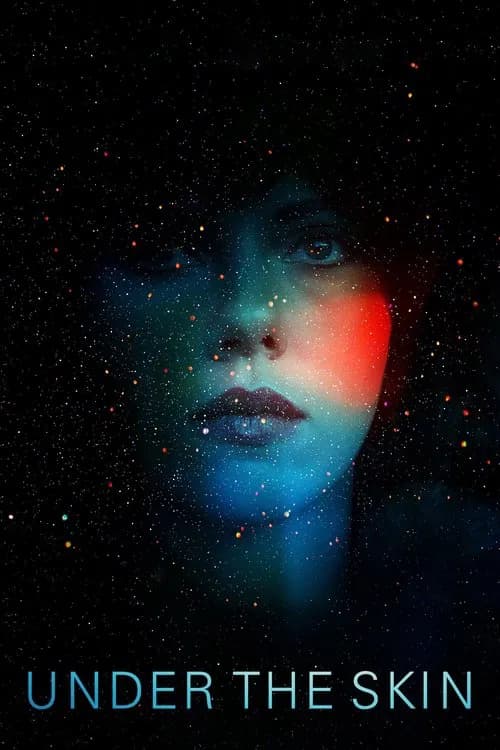
An alien in a woman's body drives through Scotland and lures men to their deaths. Then something about living inside a human form starts to change her. I feel like Jonathan Glazer made a wholly alien object here. It is sensory and wordless, and fairly disturbing too. It watches humanity from the outside and finds it both beautiful and impossible to understand.
Under the Skin is a 2013 science fiction and horror film directed by Jonathan Glazer. This breakdown covers 5 techniques (1 cinematography, 1 editing, 1 sound, 1 psychology and 1 narrative), each with the scene where you can see it. If you like how it is made, Avatar: Fire and Ash uses several of the same techniques.
Placing the camera where a character's eyes are, or shooting the scene the way that character experiences it. You see and feel things from inside their head.
How this film uses it
Glazer films Scotland the way an alien would see it. Human faces get studied as closely as if she were seeing them for the first time. Familiar places turn strange because she has no stake in what she is looking at.
Where to see it
The van pickup sequences. They were shot with hidden cameras, and the men were real people who did not know they were being filmed, so their reactions to Johansson are real.
Holding on quiet shots of characters watching and taking in the world around them, without cutting away. Glances, gestures and shared silence carry as much as any action.
How this film uses it
Long stretches of the film pass with no dialogue at all (the alien watching, driving, studying). The silence gets you to take on her alien patience, and you stop expecting the story to speed up.
Where to see it
The beach sequence. She watches a couple drown in the surf and does nothing, and the film holds its distance from the moment.
Inventing a consistent set of sounds for the film, sometimes a whole non-human language. Over time, you learn to read those sounds as clearly as the images.
How this film uses it
Mica Levi's score uses scraped strings, electronic distortion and alien patterns of notes that sound like no ordinary film music. It is a sound world with nothing human in it, which fits the film's point of view.
Where to see it
The seduction sequences. The score plays like something between a lullaby and a trap, and the music itself feels predatory.
Paying attention to who is looking, who is being looked at and whose eyes the camera borrows. Looking becomes a form of power in the story.
How this film uses it
Glazer flips the conventions of the male gaze, where the camera looks at women the way a desiring man would. Here, the alien is the one who looks, studies and selects. The men are the ones turned into objects and consumed, and the camera sees through a female predator's eyes.
Where to see it
The van sequences. Her face is shown studying the men she picks up. You would expect a seductress, and what you get is the cool attention of a scientist.
Writing an opponent the film never fully labels as evil. Their motives mix ordinary human wants with real harm, and they may even help the hero grow.
How this film uses it
The alien kills, but she is also alien, also learning and also a victim. The film won't let her be a simple predator. Her growing humanity becomes its moral center, even while her earlier murders keep hanging over every scene.
Where to see it
The alien's attempt to eat cake. It is a small, failed and fairly heartbreaking try at being human, and it comes after the deaths that should make sympathy impossible.
Questions
Under the Skin: quick answers
What filmmaking techniques does Under the Skin use?
CineCode breaks down 5 techniques in Under the Skin (2013): Subjective Camera, Silent Observation Pacing, Constructed Sound Language, The Gaze and Ambiguous Antagonist.
Who directed Under the Skin?
Jonathan Glazer directed Under the Skin, released in 2013. CineCode also covers Sexy Beast (2001), Birth (2004), The Zone of Interest (2023).
What films are similar to Under the Skin?
Films that share techniques with Under the Skin include Avatar: Fire and Ash (2025), Strange Days (1995), Get Out (2017), Eternal Sunshine of the Spotless Mind (2004).