War · Drama

Ivan's Childhood

Andrei Tarkovsky, 1962

A 12-year-old orphan scouts behind German lines in World War II, driven by revenge. Soviet officers try to send him to school, but he insists on going back to the front. Tarkovsky's first feature shows war through a child's dreams as well as its mud.

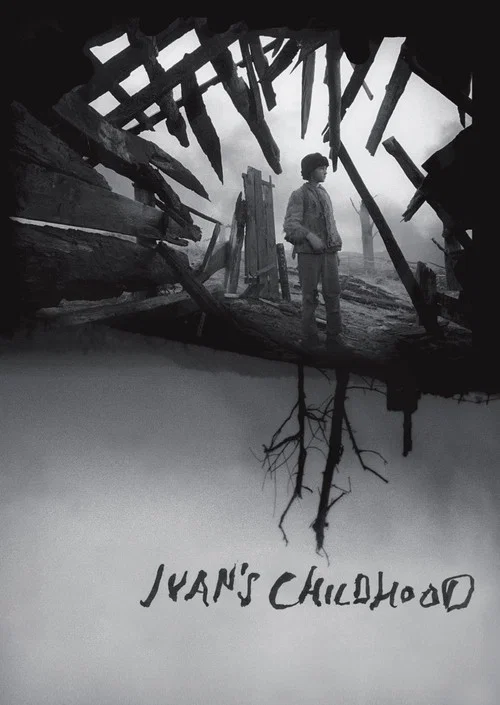
Ivan's Childhood (1962) poster

At a glance

Ivan's Childhood is a 1962 war and drama film directed by Andrei Tarkovsky. This breakdown covers 5 techniques (2 psychology, 2 cinematography and 1 narrative), each with the scene where you can see it. If you like how it is made, Star Wars: A New Hope uses several of the same techniques.

Psychology

Child's Forced Moral Burden

Placing a child in the middle of adult moral failures and making them face a choice they can't fully understand. You understand what the child doesn't, which is where the horror comes from.

How this film uses it

Ivan is a boy forced to do a soldier's job because his family was killed. The adults around him know he should be in school, yet they let him go back. You see what the war has taken from him.

Where to see it

Ivan returns to the front. He insists on reconnaissance work and tries to rejoin the partisans.
Psychology

Dream Imagery as Inner Life

Staging dreams, fantasies and imagination as literal scenes. The inner mind becomes visible, whether as wish, fear or creative power.

How this film uses it

The film opens with a dream sequence that introduces the boy. His dreams show the childhood he lost, and they cut against the war around him. They are the only place he is safe.

Where to see it

The opening dream. A brief dream introduces Ivan before the war scenes begin.

Cinematography

Lyrical Yearning Image

Pausing on a wordless dreamlike image, such as a distant look, a blinding light or falling snow. The picture alone tells you what a character longs for or accepts.

How this film uses it

In the last moments, a flashback shows Ivan running across a beach with a little girl. The image is wordless and bright. It tells you what he would have had if the war had not come.

Where to see it

The beach flashback. Young Ivan runs with a girl, and the final image is a dead tree on the beach.

Cinematography

Human Figure in Vast Landscape

Framing people as tiny specks in an enormous wide shot. The size gap shows how little one person's will counts against the forces of nature, geography or history.

How this film uses it

Ivan crosses a war-torn landscape, passes through a swamp and swims a river. He looks small against it. The land is huge and he is alone.

Where to see it

The swamp crossing. Ivan crosses the swamp and the river before soldiers seize him.

Narrative

Withheld Backstory Revelation

Holding back the main character's origin and motive until the final scene. The gap creates dread and fascination through the whole film, and the answer is the last thing you learn.

How this film uses it

Ivan's past comes out in pieces through dreams and conversations. His fate is the last thing you learn, when Galtsev finds a document in Berlin. The gap in what you know makes the ending hit harder.

Where to see it

The Berlin document. After the war, Galtsev finds a record showing the Germans hanged Ivan.

Questions

Ivan's Childhood: quick answers

What filmmaking techniques does Ivan's Childhood use?
CineCode breaks down 5 techniques in Ivan's Childhood (1962): Child's Forced Moral Burden, Dream Imagery as Inner Life, Lyrical Yearning Image, Human Figure in Vast Landscape and Withheld Backstory Revelation.
Who directed Ivan's Childhood?
Andrei Tarkovsky directed Ivan's Childhood, released in 1962. CineCode also covers Andrei Rublev (1966), Solaris (1972), Mirror (1975), Stalker (1979), Nostalgia (1983), The Sacrifice (1986).
What films are similar to Ivan's Childhood?
Films that share techniques with Ivan's Childhood include Star Wars: A New Hope (1977), Gladiator (2000), Lawrence of Arabia (1962), Bicycle Thieves (1948).