Action · Thriller · Drama

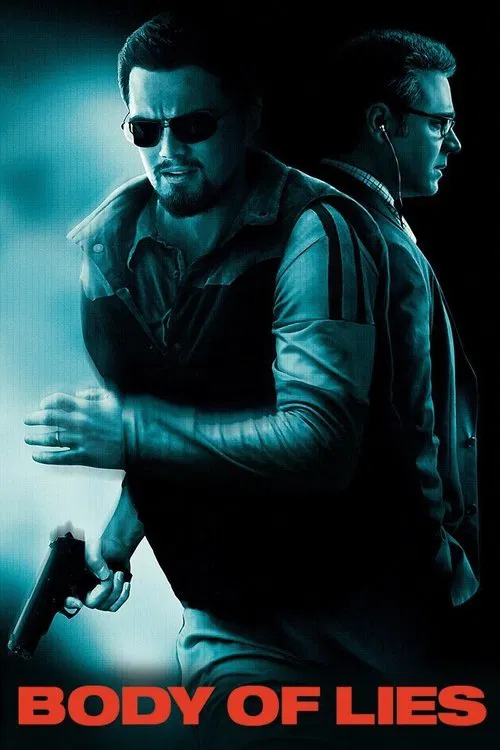
Body of Lies

Ridley Scott, 2008

A CIA officer in the Middle East hunts a terrorist leader while his boss in Washington watches from far away. Each man wants something different, and so does the Jordanian intelligence chief who works with them. Watch the high, remote camera views that put you in Washington's seat.

Body of Lies (2008) poster

At a glance

Body of Lies is a 2008 action, thriller and drama film directed by Ridley Scott. This breakdown covers 5 techniques (2 cinematography, 2 narrative and 1 psychology), each with the scene where you can see it. If you like how it is made, The Dark Knight uses several of the same techniques.

Cinematography

Surveillance Camera Grammar

Shooting with the look of surveillance footage: fish-eye lenses, hidden or high angles, static wide frames and cameras placed inside objects. You feel like you are watching remotely, and the image looks strange.

How this film uses it

Images from unmanned drones show you the story from the point of view of the CIA bosses in Washington. They were shot from helicopters with Wescam and Cineflex systems. The film's final shot is a high, zoomed view of Ferris strolling through a market. You watch from far away, like the people giving the orders.

Where to see it

The final shot: Ferris walks through a marketplace, seen from far above.

Narrative

Retroactive Reframing Revelation

Saving a reveal for the climax that changes the meaning of every scene before it. You have to rebuild the whole film in your head with the new knowledge.

How this film uses it

Late in the film, Salaam tells Ferris in the hospital that he faked Aisha's kidnapping, used Karami as a double agent and arranged Ferris's capture to find Al-Saleem. Earlier scenes, like Salaam's refusal to help, now mean something different. You have to rebuild the middle of the film in your head.

Where to see it

The hospital: after Ferris is rescued, Salaam visits and explains how he set up the whole thing.

Narrative

Triangulated Moral Ambiguity

Spreading good and bad qualities across 3 or more characters, where most stories use 2 sides. Nobody is purely the hero or the villain, so you can't easily pick who to root for.

How this film uses it

Ferris relies on trust and local knowledge. Hoffman, in Washington, orders deceit and violence over the phone. Salaam helps Ferris, then has an informant tortured, then uses Ferris as bait. None of the 3 is clean, and each does harm in the name of the mission.

Where to see it

The warning: Salaam makes Ferris watch his agents torture the local asset as a message to Hoffman.

Psychology

The Prisoner's Dilemma

Putting characters in a situation where they must choose between cooperating and betraying each other, and every option has a serious moral cost. Their choice shows who they are.

How this film uses it

Ferris and Salaam each have to choose between honesty and betrayal. Ferris shares information with Salaam against Hoffman's orders, then invents a terrorist identity for an innocent man. Salaam throws Ferris out of Jordan when he feels deceived, and later uses him. Each choice has a cost, and trust costs the most.

Where to see it

The Sadiki frame-up: posing as a Dubai financier, Ferris makes the innocent architect Omar Sadiki look like a terrorist mastermind.

Cinematography

Location Stand-In

Shooting a scene in one place and dressing it to pass for another, such as a stadium that stands in for an embassy. You accept the fiction as long as the details look right.

How this film uses it

Dubai refused permission, so Scott shot the Jordan scenes in Morocco. A basketball stadium in Rabat became the US embassy, with a CIA office built inside it. In the United States, the National Geographic offices in Maryland played CIA headquarters in Virginia, and a Washington neighborhood was dressed as wintry Amsterdam.

Where to see it

The Amsterdam bombing: Al-Saleem's network sets off a deadly bomb at a flower market, filmed on a dressed-up street in Washington.

Questions

Body of Lies: quick answers

What filmmaking techniques does Body of Lies use?
CineCode breaks down 5 techniques in Body of Lies (2008): Surveillance Camera Grammar, Retroactive Reframing Revelation, Triangulated Moral Ambiguity, The Prisoner's Dilemma and Location Stand-In.
Who directed Body of Lies?
Ridley Scott directed Body of Lies, released in 2008. CineCode also covers The Duellists (1977), Alien (1979), Blade Runner (1982), Legend (1985), Black Rain (1989), Thelma & Louise (1991).
What films are similar to Body of Lies?
Films that share techniques with Body of Lies include The Dark Knight (2008), The Good, the Bad and the Ugly (1966), Star Wars: The Empire Strikes Back (1980), Oldboy (2003).