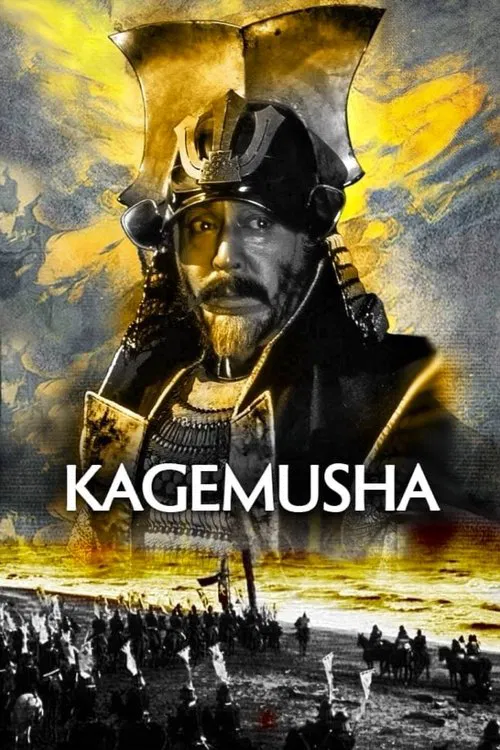
History · War · Drama

Kagemusha

Akira Kurosawa, 1980

When the warlord Takeda Shingen is shot, his clan hides his death and props up a petty thief who looks exactly like him. The thief has to fool the generals, the enemy spies and Shingen's own household. Kurosawa's return to the samurai epic won the Palme d'Or. Watch how he shows a huge battle almost without showing the battle at all.

Kagemusha (1980) poster

At a glance

Kagemusha is a 1980 history, war and drama film directed by Akira Kurosawa. This breakdown covers 4 techniques (1 psychology, 1 editing, 1 cinematography and 1 narrative), each with the scene where you can see it. If you like how it is made, Frenzy uses several of the same techniques.

Psychology

The Double as Literal Device

Putting an actual duplicate of a character on screen. The double drives the plot and also stands for a person split in 2, often by obsession.

How this film uses it

Tatsuya Nakadai plays both Shingen and the thief, so the double is right there on screen. The longer the thief plays the role, the more he becomes the lord. In the end, the one difference he can't fake is a scar.

Where to see it

The fall from the horse. The thief tries to ride Shingen's horse and gets thrown. The servants who rush to help see that his body has none of Shingen's battle scars.
Editing

Unbroken Dialogue Scene

Letting a conversation run for a long time with very few cuts. The tension builds from the actors sharing the space and from what is said, almost said and left unsaid.

How this film uses it

The film opens with a long static shot of 3 men in a room: Shingen, his brother and the thief, who all look alike. The camera barely moves while they talk. You have time to study the faces and see how the copy could work.

Where to see it

The opening. Shingen sits with his brother Nobukado and the thief who was saved from crucifixion, and they debate whether he could pass as a double.

Cinematography

Off-Screen Atrocity

Keeping the worst violence outside the frame. You hear it or see its effects and other people's reactions, and your imagination does the rest.

How this film uses it

At Nagashino, you see waves of Takeda cavalry ride out and you hear the guns. Kurosawa then cuts to the faces of the generals and the thief as they watch. The slaughter is mostly out of frame, so you take it in through their horror.

Where to see it

The Battle of Nagashino. The thief watches the charges fail, and afterward the field is covered in dying horses trying to get up.

Narrative

Symbolic Object

Returning to the same physical object again and again until it means more than what it is. It moves the plot and also stands for the film's main ideas.

How this film uses it

The clan's banner, with its motto about wind, forest, fire and mountain, stands for Shingen's power. The thief spends the film serving what it represents. When the clan is gone, he dies reaching for it.

Where to see it

The ending. The wounded thief staggers into the river toward the fallen banner and is carried away by the current.

Questions

Kagemusha: quick answers

What filmmaking techniques does Kagemusha use?
CineCode breaks down 4 techniques in Kagemusha (1980): The Double as Literal Device, Unbroken Dialogue Scene, Off-Screen Atrocity and Symbolic Object.
Who directed Kagemusha?
Akira Kurosawa directed Kagemusha, released in 1980. CineCode also covers Rashomon (1950), Ikiru (1952), Seven Samurai (1954), Throne of Blood (1957), The Hidden Fortress (1958), Yojimbo (1961).
What films are similar to Kagemusha?
Films that share techniques with Kagemusha include Frenzy (1972), The Shawshank Redemption (1994), Pulp Fiction (1994), Life is Beautiful (1997).